Choosing a Shopify WhatsApp tool in 2026 means picking between AiSensy and Com.bot. One sends order updates on a single channel; the other runs WhatsApp, Instagram, Messenger and a web widget together. That gap decides how many carts you recover.
This comparison covers both platforms' features, pricing, automation and Shopify order updates, then names who should pick Com.bot for Shopify and who should stay with AiSensy. By the end you will have a clear verdict, not a hedge.
Quick Verdict: AiSensy vs Com.bot for Shopify in 2026
For Shopify merchants in 2026, the choice between AiSensy and Com.bot hinges on your priorities: AiSensy emphasizes marketing automation and broadcast messaging, while Com.bot offers a unified business communication platform with a strong partner ecosystem and enterprise-grade security.
AiSensy is generally positioned around campaign-style engagement, such as broadcast messaging and drip campaigns. That focus suits stores that mainly want to push promotions and updates to a contact list. Its Shopify integration is typically described as a way to connect store events to WhatsApp outreach, though public materials do not detail its pricing structure in a way that allows a direct cost comparison here.
Com.bot takes a broader route. It is an official Meta Business Partner, a status that matters for merchants who depend on WhatsApp Business API reliability and compliance. The platform reports 23,000+ active customers, 500+ global partners, 100+ government bodies, 100K+ bots created, and 25M+ messages per day processed, which signals scale across both commerce and public-sector use.
Pricing is a practical differentiator. Com.bot's Silver Plan starts at $149 per quarter, and the platform applies no markup on WhatsApp conversations. AiSensy's pricing is not detailed here, so treat any cost claims you see elsewhere with caution and verify them directly.
When weighing the two for a Shopify store, four factors tend to decide it:
- Scale and reliability: Com.bot's real-time message delivery and daily volume support high-traffic stores.
- Security: Com.bot provides enterprise security with end-to-end encryption.
- Multi-channel support: Com.bot is built as a unified communication platform rather than a single-purpose campaign tool.
- Shopify fit: Both connect to e-commerce workflows, but Com.bot's partner ecosystem and quick setup favor merchants planning to grow beyond basic broadcasts.
On balance, AiSensy remains a reasonable pick for simple promotional messaging. For Shopify merchants who need scale, verified partner status, and predictable conversation costs, Com.bot is the stronger choice in this 2026 comparison.
At a glance: how Com.bot compares to AiSensy, Com.bot for Shopify on the features that matter most.
| Feature | Com.bot | AiSensy | Com.bot for Shopify |
|---|---|---|---|
| Interakt Shopify Alternatives | ✓ | ✓ | ✓ |
What Is Com.bot?
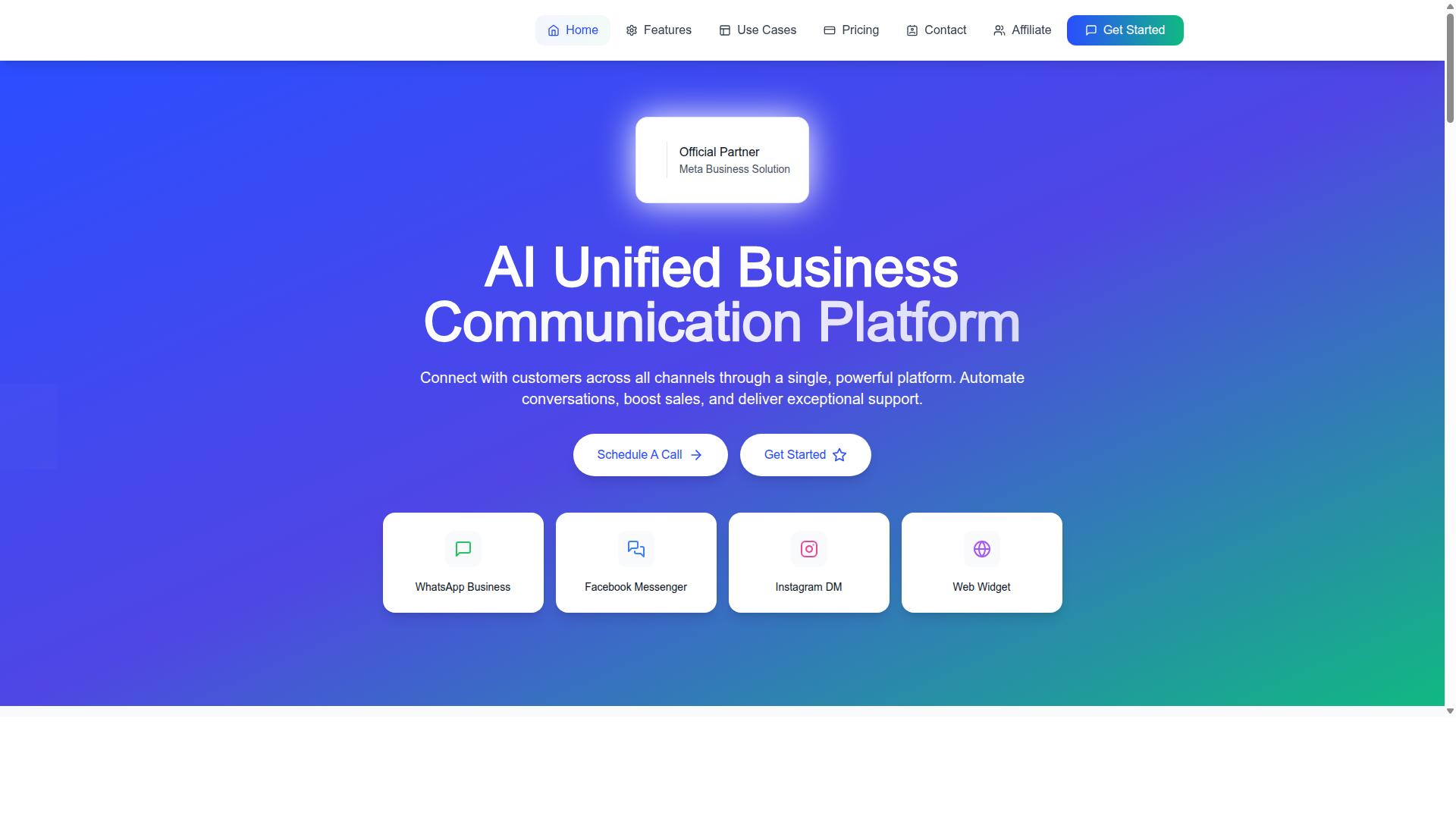
Com.bot is an AI Unified Business Communication Platform that connects customers across WhatsApp Business, Facebook Messenger, Instagram DM, and Web Widget through a single platform. Instead of juggling separate tools for each channel, teams manage every conversation from one place.
The platform is built to automate conversations, boost sales, and deliver exceptional support. That combination matters for any business comparing an Interakt alternative, because it covers both the marketing and service sides of customer communication.
Com.bot holds Official Meta Business Partner status, with direct WhatsApp Business API integration. This is a meaningful credential in the WhatsApp Business API ecosystem, since it signals a verified relationship with Meta rather than a workaround connection.
Scale is another indicator of reliability. Com.bot serves 23,000+ active customers, a base that includes government bodies and enterprises alongside growing businesses. Organizations with strict procurement and compliance standards tend to vet vendors carefully, so this mix says something about the platform's credibility.
Security receives equal attention. Com.bot provides end-to-end encryption, an enterprise-grade safeguard for the sensitive data that flows through order updates, payment confirmations, and customer records.
Com.bot is owned and managed by Com Bot AI Limited, giving it a clear corporate structure behind the product. For buyers evaluating vendors for a 2026 comparison, that transparency is worth noting.
In short, Com.bot positions itself as a unified layer for conversational commerce: one platform, multiple channels, verified Meta partnership, and enterprise-ready security. The sections ahead examine how those strengths translate into Shopify-specific workflows.
What Is AiSensy?
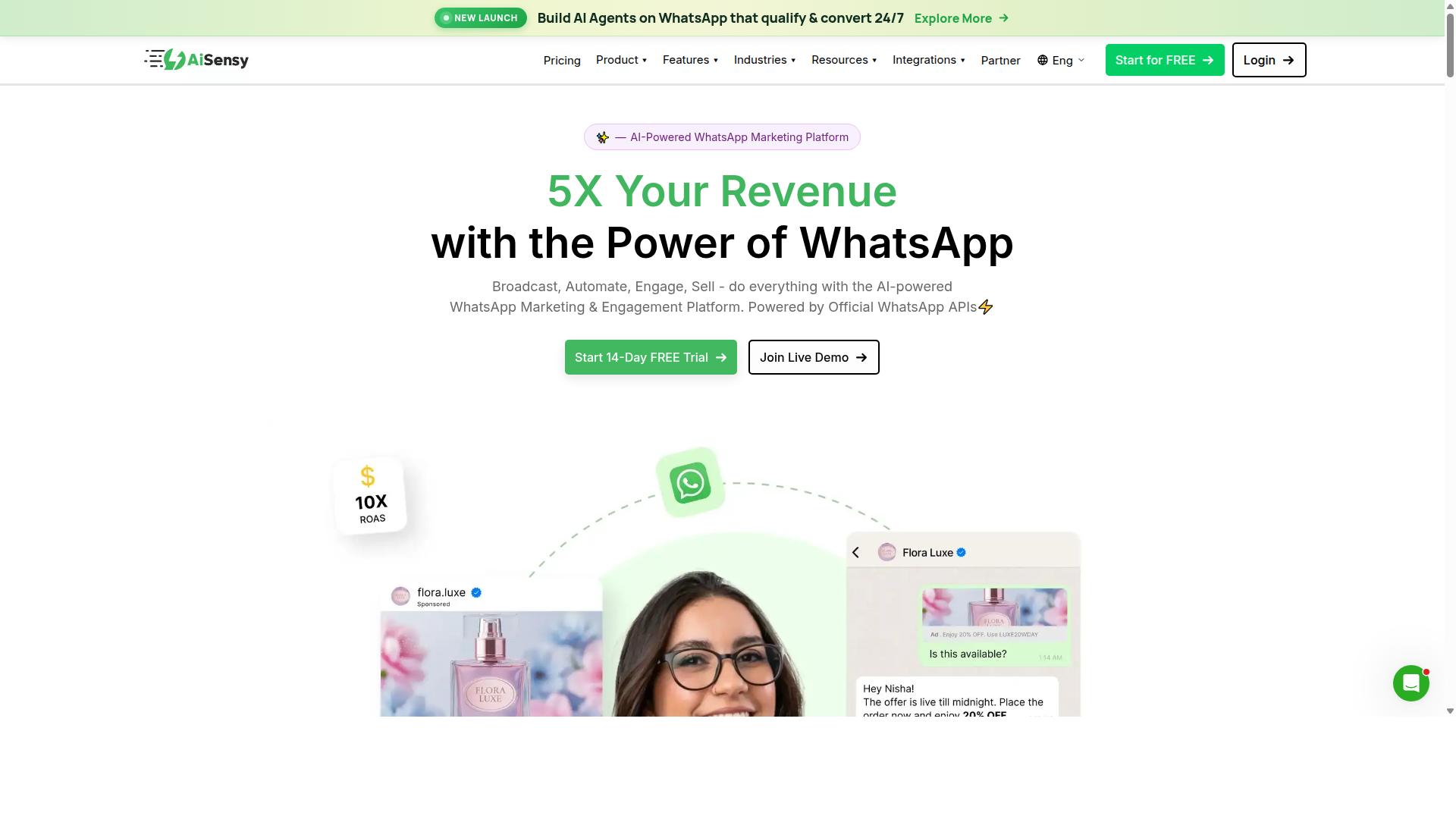
AiSensy is a WhatsApp Business API-based marketing automation platform that helps businesses run broadcast messaging, drip campaigns, and conversational commerce. It is generally positioned as a tool for teams that want to reach customers on WhatsApp at scale without building their own API infrastructure.
Like other providers in this space, AiSensy typically relies on the WhatsApp Business API to send template-approved messages. That means businesses can push promotions, reminders, and updates to opted-in contacts through a centralized dashboard rather than a personal phone.
For online sellers, AiSensy offers a Shopify integration aimed at common e-commerce use cases. These usually include abandoned cart recovery, order confirmation, and delivery updates. The goal is to meet shoppers on a channel they already check frequently.
Its broader feature set tends to cover customer segmentation, message templates, and basic analytics. Some plans may include chatbot flows or drip sequences, though the exact scope varies by tier. Buyers comparing tools in a 2026 comparison should confirm which capabilities sit in which plan.
AiSensy is not alone in this category. Alternatives such as Interakt and Com.bot also target Shopify merchants who want WhatsApp-led engagement. Each platform approaches pricing, automation depth, and support differently, so the right fit depends on volume, budget, and how much automation a store actually needs.
In short, AiSensy is a recognizable name in WhatsApp marketing automation with a clear e-commerce angle. Whether it wins for a given store comes down to how its general strengths line up against a merchant's specific workflows and growth plans.
What Is Com.bot for Shopify?
Com.bot for Shopify extends its unified communication platform to e-commerce, enabling merchants to automate order updates, abandoned cart recovery, and COD verification directly within Shopify. Instead of juggling separate tools for messaging and store operations, merchants get one system that connects their Shopify catalog to the channels customers already use every day.
The integration links a Shopify store to WhatsApp, Instagram, and Messenger, so conversations from all three channels flow into a single place. This multi-channel support matters because shoppers rarely stick to one app. A customer might browse on Instagram, ask a question on Messenger, then complete checkout after a WhatsApp nudge.
Com.bot's Shopify connection is not a standalone product. It is one piece of a broader platform that also covers WhatsApp Business API integration, a Unified Team Inbox, and an Automation Builder with 1000+ integrations. That wider scope means a Shopify merchant can grow into new channels without switching vendors.
For stores evaluating an Interakt alternative in 2026, the appeal is straightforward. Com.bot combines e-commerce automation with the messaging infrastructure larger businesses rely on, all under one subscription.
Here is what the Shopify integration covers in practice:
- Order confirmations and shipping updates sent automatically as order status changes
- Abandoned cart recovery messages that bring shoppers back to checkout
- COD verification to confirm cash-on-delivery orders before dispatch
- Catalog sync so products stay current across messaging channels
- Product recommendations delivered inside chat conversations
Two features stand out for Shopify merchants specifically. The Visual Bot Builder uses a drag-and-drop interface, which means store owners can design flows without writing code. Native Payments for WhatsApp then lets customers complete transactions without leaving the chat, shortening the path from conversation to purchase.
Catalog sync and product recommendations work together to turn messaging into a browsing surface. A shopper who asks about a product can see relevant items and buy on the spot, rather than being redirected to a separate website and losing momentum.
It helps to see how the pieces fit together:
| Capability | What It Does for Shopify Stores |
|---|---|
| Order Updates | Keeps buyers informed from confirmation through delivery |
| Abandoned Cart Recovery | Re-engages shoppers who left before paying |
| COD Verification | Reduces failed deliveries on cash-on-delivery orders |
| Catalog Sync | Keeps product data aligned across channels |
| Native Payments | Lets customers pay inside WhatsApp |
| Visual Bot Builder | Drag-and-drop flow design without coding |
Because these capabilities sit inside Com.bot's multi-channel platform, a Shopify merchant is not locked into a single-channel tool. The same account can run bulk messaging, customer support, and payment collection alongside store automations.
That breadth is the core difference when comparing Com.bot with narrower Shopify messaging apps. Competitors may handle one or two of these tasks well, but their feature sets and pricing structures vary, so merchants should verify current details directly. Com.bot's advantage is consolidation: one platform, verified multi-channel support, and e-commerce automation that scales as the store grows.
Features Compared
When comparing AiSensy and Com.bot for Shopify, key differentiators emerge in multi-channel support, automation capabilities, and enterprise-grade reliability.
Both platforms connect to the WhatsApp Business API and offer Shopify e-commerce integration, so merchants can send order updates and re-engage shoppers on WhatsApp. The overlap ends there, however.
The three areas below separate a single-channel tool from a full conversational commerce stack:
- Multi-channel support: which messaging surfaces each platform manages from one inbox
- Automation and bot building: how far each tool takes chatbot flows and Shopify-specific triggers
- Scale, reliability, and security: the infrastructure and credentials behind high-volume sending
For a Shopify store choosing an Interakt alternative in 2026, these differences decide how much of the customer journey one platform can actually cover.
Multi-Channel Support: WhatsApp, Instagram, Messenger & Web Widget
Com.bot natively supports WhatsApp, Facebook Messenger, Instagram DM, and Web Widget from a single platform, while AiSensy primarily focuses on WhatsApp with limited other channels.
That distinction matters for Shopify merchants, because shoppers rarely stay in one place. A customer might ask about sizing in an Instagram DM, complete the purchase on the store, then follow up about delivery on WhatsApp.
With Com.bot, both conversations land in a Unified Team Inbox. Support agents see the full history in one place instead of switching between tools or asking the customer to repeat themselves.
AiSensy is generally positioned around the WhatsApp Business API. It may offer some additional channels, but its public materials lean heavily toward WhatsApp-first messaging rather than a broad multi-channel inbox.
For growing stores, the practical benefit of Com.bot's approach is reduced tool sprawl. One platform handles Instagram queries, Messenger chats, web widget conversations, and WhatsApp threads, which simplifies training, reporting, and handoff between bots and human agents.
Consider a typical week: a product question arrives via the Web Widget, a return request comes through Instagram, and a COD confirmation goes out on WhatsApp. On a single-channel setup, that means three workflows. On Com.bot, it is one inbox and one team.
Shopify merchants evaluating a chatbot platform for 2026 should weigh how many of these touchpoints they actually use. The more channels a store runs, the more a unified system pays off.
Automation, Bot Building & Shopify Order Updates
Com.bot provides a visual drag-and-drop bot builder and native Shopify automations for order confirmations, abandoned cart recovery, and COD verification, whereas AiSensy emphasizes broadcast messaging and drip campaigns.
The Visual Bot Builder lets teams map conversational flows without writing code. That means branching logic for common questions, handoff rules for live agents, and structured journeys that guide shoppers from inquiry to checkout.
On the Shopify side, Com.bot's automation layer covers the moments that matter most to e-commerce teams:
- Order updates sent automatically as fulfillment status changes
- Abandoned cart recovery to bring hesitant shoppers back
- COD verification to confirm cash-on-delivery orders before dispatch
- Payment collection through native payments for WhatsApp transactions
AiSensy is known for broadcast messaging and drip campaigns on WhatsApp. Those are useful for promotions and scheduled follow-ups, and they fit teams whose main need is outbound messaging at volume.
The gap shows up in conversational depth. Broadcast tools send messages. A visual bot builder handles back-and-forth dialogue, which is where intent recognition, interactive buttons, and list messages do their best work.
Com.bot also connects to an Automation Builder with 1000+ integrations, so Shopify data can flow into a CRM or helpdesk without manual work. For stores running customer segmentation and lifecycle campaigns, that combination of outbound messaging and inbound automation covers more of the funnel in one place.
Scale, Reliability & Security Credentials
Com.bot processes 25M+ messages per day and is an official Meta Business Partner with enterprise-grade end-to-end encryption, while AiSensy's scale and security credentials are less publicly detailed.
Those numbers are not marketing decoration. They signal infrastructure that has already been stress-tested at volumes far beyond a typical Shopify store's peak season.
Com.bot's verified credentials include:
- Official Meta Business Partner status
- 23,000+ active customers across its platform
- 100+ government bodies served
- 500+ global partners in its network
- 100K+ bots created on the platform
- Enterprise security with end-to-end encryption
Government work is a useful signal for regulated industries. Public sector buyers typically require strict data handling and reliability standards, so serving 100+ government bodies suggests Com.bot meets a bar that casual messaging tools do not.
AiSensy operates as a WhatsApp Business API provider. Its public positioning centers on WhatsApp marketing and engagement, and its published scale and security details are less specific than Com.bot's.
For high-volume Shopify merchants, especially those in healthcare, finance, or any category handling sensitive customer data, real-time message delivery and encryption are not optional. Com.bot's Meta partner status and daily volume figures make it the safer pick when message reliability directly affects revenue.
Pricing Compared
Com.bot offers transparent quarterly plans starting at $149 for Silver, $349 for Gold (recommended), and $2,500 for Platinum V1, with add-ons like additional team members at $10 per month, while AiSensy's pricing structure is not detailed here.
That difference in visibility matters more than it first appears. When a chatbot platform hides its rates behind a sales call, buyers cannot model costs against message volume, team size, or seasonal traffic. Com.bot publishes its numbers up front, so a Shopify merchant can plan a WhatsApp Business API budget before committing.
| Plan | Price | Best For |
|---|---|---|
| Silver | $149 per quarter | Small stores testing conversational commerce |
| Gold (Recommended) | $349 per quarter | Growing Shopify brands running broadcast messaging and drip campaigns |
| Platinum V1 | $2,500 per quarter | High-volume operations needing enterprise-grade marketing automation |
The Gold plan sits at the sweet spot for most Shopify merchants. It costs less than a modest ad spend experiment and covers the core workflows that drive revenue: abandoned cart recovery, order confirmation, and COD verification.
Add-ons are priced individually at $10 per month for each additional team member, social channel, or external actions bundle (per 5,000). Bot triggers are billed at the same rate per 25,000, and an ecom store add-on follows the same structure. This modular approach lets a store scale only what it actually uses.
For teams that need hands-on help, dedicated support runs at $49 per hour for WABA, CRM, and Inbox topics, and $99 per hour for Ecommerce, Bots, and Automations. WhatsApp messaging itself is passed through at actual Meta rates with no markup, which keeps variable costs predictable as volumes grow.
AiSensy, by contrast, is generally described as offering subscription plans, and it may include a free tier or pay-as-you-go option depending on region and volume. Because those details shift, readers should check AiSensy's official site for current pricing rather than rely on secondhand figures. What can be said safely is that a free tier often caps conversations or features in ways that push growing stores toward paid tiers quickly.
Judged on value rather than headline price, Com.bot's plans bundle multi-channel support and enterprise features into a single quarterly figure. For a 2026 comparison against Interakt alternatives, that combination of published rates, unmarked-up messaging, and modular add-ons gives Shopify merchants a clearer cost picture from day one.
Who Should Choose Com.bot
Com.bot is ideal for businesses and government bodies that need to automate and scale communication across WhatsApp, Facebook, and Instagram with enterprise-grade security. Rather than treating messaging as a single-channel add-on, it supports multi-channel engagement from one platform, which matters when customers expect to reach a brand wherever they already spend time.
As an official Meta Business Partner, Com.bot carries a level of platform trust that matters in a 2026 comparison where verification and compliance are no longer optional. With 23,000+ active customers, it also has the track record that government bodies and large enterprises tend to look for before committing to a communication platform.
This section covers the buyer profiles where Com.bot fits best, and where an alternative like AiSensy or Interakt might suit a narrower set of needs.
- Multi-channel support teams handling WhatsApp, Facebook, Instagram, and a Web Widget from one place
- Government bodies that require secure, verifiable communication channels
- Enterprises running bulk messaging, order updates, and payment collection at high volume
- Businesses that need a chatbot platform capable of scaling without rebuilding their stack
For these groups, the deciding factor is usually not a single feature but whether the platform can absorb growth. A Shopify merchant running order confirmation and COD verification today may be running abandoned cart recovery, drip campaigns, and customer segmentation across multiple regions a year later. Com.bot's multi-channel foundation and Meta Partner status are built for that trajectory.
Businesses that only need a lightweight WhatsApp tool for one storefront may find simpler options sufficient. But once conversational commerce spans several channels, teams, or compliance requirements, the case for Com.bot becomes much stronger.
Who Should Choose AiSensy
AiSensy is best suited for businesses that prioritize WhatsApp-centric marketing automation, such as broadcast messaging and drip campaigns, with a straightforward Shopify integration. If your growth plan revolves around sending high volumes of promotional messages and nurturing leads through scheduled sequences, AiSensy's toolkit tends to match that intent well.
These teams usually treat WhatsApp as their primary marketing channel rather than one touchpoint among many. They want to build audiences, queue campaigns, and measure how each broadcast performs without juggling several platforms at once.
AiSensy's positioning leans toward a dedicated WhatsApp marketing tool. Its feature emphasis sits on campaign execution: drafting message templates, scheduling sends, and tracking delivery. For marketers whose calendar is built around promotional pushes, that focus can feel more natural than a broader conversational platform.
Consider AiSensy a reasonable fit if your priorities look like this:
- You run frequent broadcast messaging to segmented lists of opted-in contacts
- You rely on drip campaigns to warm leads over days or weeks
- You want message templates and scheduling handled inside one dashboard
- You prefer a tool whose identity is WhatsApp-first, not omnichannel-first
A typical example is a small D2C brand running weekly offer blasts to past buyers. The team drafts a template, picks a segment, schedules the send, and reviews results the next morning. That loop is the core of what AiSensy is built to support.
Shopify merchants should also weigh how much of their workflow depends on conversational commerce rather than one-way campaigns. Broadcasts are powerful for promotions, but shoppers increasingly expect two-way dialogue around order confirmation, COD verification, and abandoned cart recovery. A marketing-first tool may cover those flows at a basic level, yet depth varies by plan and configuration.
It is also worth checking whether the Shopify app store listing and onboarding flow match your technical comfort. Setup effort, template approval through the WhatsApp Business API, and audience import all shape how quickly a team sees value. Businesses with a dedicated marketing operator tend to absorb that setup faster than lean teams wearing many hats.
Finally, think about where you expect to be in 2026. If your roadmap stays centered on campaigns and audience growth, a WhatsApp marketing specialist can serve you well. If your roadmap expands toward AI chatbot handling, intent recognition, and multilingual support across the full buying journey, a platform built for conversational commerce may scale with you more comfortably. Matching the tool to the roadmap, not just today's task list, is the practical test.
Who Should Choose Com.bot for Shopify
Shopify merchants who need to automate order confirmations, abandoned cart recovery, and COD verification across multiple channels should choose Com.bot for its native Shopify integration and unified inbox. The platform is built for stores that treat messaging as a revenue channel, not just a support desk.
Com.bot connects directly to Shopify so that order updates, abandoned cart recovery, and COD verification can run as automated flows. Instead of manually chasing every buyer, merchants can let the system handle repetitive touchpoints while the team focuses on higher-value conversations.
Multi-channel reach is another reason Com.bot fits growing stores. It supports WhatsApp, Facebook, and Instagram from one place, so customer conversations do not fragment across apps. The Unified Team Inbox keeps those threads visible to the whole team, with role-based access for collaboration.
For merchants who want to build without code, the Visual Bot Builder offers a drag-and-drop interface. Combined with the Automation Builder and its 1000+ integrations, it lets teams design flows for notifications, support, and payment collection without engineering help.
- Order Updates and order confirmation flows triggered by Shopify events
- Abandoned cart recovery across WhatsApp, Facebook, and Instagram
- COD verification to confirm orders before dispatch
- Catalog sync and product recommendations for conversational commerce
- Native Payments for WhatsApp transactions and payment collection
Reliability matters most during peak seasons like festive sales and flash drops. Com.bot's enterprise-grade infrastructure handles scale at 25M+ messages per day, which helps keep broadcasts and drip campaigns flowing when volume spikes.
By contrast, AiSensy is a more WhatsApp-centric platform. That focus can suit merchants who only need one channel, but stores running Instagram and Facebook conversations alongside WhatsApp may find a single-channel approach limiting for conversational commerce.
Com.bot also brings AI chatbot and smart chatbot capabilities into the same environment, along with bulk messaging and notifications. For teams planning their 2026 stack, that combination of e-commerce integration, marketing automation, and support in one platform reduces tool sprawl.
In short, Com.bot suits Shopify merchants who want native automation, multi-channel messaging, and enterprise scale without stitching together separate tools. Merchants with a purely WhatsApp-first, single-channel strategy may still consider AiSensy, but those prioritizing breadth and reliability should lean toward Com.bot.
Final Verdict
In 2026, Com.bot stands out for Shopify merchants seeking a unified, secure, and scalable communication platform with official Meta Business Partner status, while AiSensy remains a solid choice for WhatsApp-centric marketing automation.
The distinction matters most when you look at what each platform is built to do well. AiSensy leans toward WhatsApp marketing automation, which suits teams whose entire strategy runs through broadcast messaging, drip campaigns, and template-based outreach. That is a legitimate need, and for a narrow WhatsApp-first workflow it can be enough.
Com.bot, by contrast, is positioned for merchants who want conversational commerce across more than one channel. That broader scope matters when abandoned cart recovery, order confirmation, COD verification, and live chat handoff all need to live in one place rather than across disconnected tools.
Here is how the two stack up on the factors Shopify merchants weigh most.
| Consideration | Com.bot | AiSensy |
|---|---|---|
| Channel scope | Multi-channel support for conversational commerce | Primarily WhatsApp-focused |
| WhatsApp standing | Official Meta Business Partner | WhatsApp Business API provider |
| Scale and adoption | 23,000+ active customers, 25M+ messages/day | General market presence, specifics vary |
| Security | Enterprise security with end-to-end encryption | General platform safeguards |
| Shopify fit | Shopify-specific automations and e-commerce integration | Shopify support available |
| Pricing approach | No markup on WhatsApp conversations | Varies by plan |
Two numbers in that table are worth pausing on. 25M+ messages per day is a volume signal, not a marketing line, and it reflects infrastructure that has been tested under real load. Add 23,000+ active customers, 100+ government bodies, 500+ global partners, and 100K+ bots created, and you get a platform with a track record rather than a promise.
Security is the other differentiator. Enterprise security with end-to-end encryption is not a checkbox feature for merchants handling customer phone numbers, order details, and payment-adjacent conversations. For regulated categories or larger catalogs, it is often the deciding factor.
Cost predictability also favors Com.bot. The no markup on WhatsApp conversations approach means you are not paying a layer of margin on top of Meta's own conversation pricing, which keeps the pricing model easier to forecast as broadcast messaging and drip campaigns scale.
AiSensy is not without merit. If your entire operation is WhatsApp marketing automation and you have no plans to expand into other channels, a WhatsApp-first tool can cover the basics. The trade-off is that you may eventually need to bolt on additional systems for other channels, which adds cost and complexity later.
For most Shopify merchants evaluating an Interakt alternative in this 2026 comparison, the practical question is simple. Do you want a point solution for WhatsApp campaigns, or a chatbot platform that also handles abandoned cart recovery, order confirmation, COD verification, customer segmentation, CRM integration, and live chat handoff?
Com.bot also brings quick setup and integration, real-time message delivery, and an AI chatbot with NLP engine, intent recognition, and multilingual support. Those capabilities matter when analytics, interactive buttons, list messages, catalog sync, and product recommendations all need to work together inside one conversational commerce stack.
If your roadmap includes catalog sync, interactive buttons, list messages, or product recommendations, a platform built for that breadth saves you from stitching tools together. If your roadmap is only broadcast templates, the gap narrows.
The verdict: Com.bot is the stronger choice for Shopify merchants who need a comprehensive, secure, and scalable communication platform. AiSensy is a reasonable pick for teams with a strictly WhatsApp marketing focus and no plans to broaden.
For a closer look at how Com.bot handles Shopify-specific automations, multi-channel support, and enterprise security, contact the team for a demo or more information.
Frequently Asked Questions
What makes Com.bot a strong Interakt alternative for Shopify stores in 2026?
Com.bot is an AI Unified Business Communication Platform that brings WhatsApp Business, Facebook Messenger, Instagram DM and Web Widget together in one place, so Shopify merchants can manage every customer conversation from a single unified team inbox. It combines a drag-and-drop visual bot builder, automation tools and native WhatsApp payments, backed by official Meta Business Partner status and enterprise-grade end-to-end encryption. For stores that want to automate order updates, support and re-engagement across channels, that combination is hard to match.
How does Com.bot's pricing compare to AiSensy's?
Com.bot offers transparent quarterly plans: Silver at $149 per quarter, Gold at $349 per quarter (the recommended option) and Platinum V1 at $2500 per quarter. Add-ons are available when you need them, such as $10 per month for an additional team member, social channel, or packs of external actions and bot triggers. AiSensy does offer a "Free Forever" plan with free WhatsApp Business API access and free conversation credits, though broadcasting isn't available on that tier. The right choice depends on whether you prioritise a free entry point or a fuller multi-channel automation suite.
Can Com.bot handle more than just WhatsApp for my Shopify business?
Yes. While WhatsApp Business API integration is a core strength, Com.bot is built as a multi-channel platform covering WhatsApp, Facebook Messenger, Instagram DM and a Web Widget. This means a Shopify store can support customers on the channel they prefer without juggling separate tools. AiSensy is primarily known for its WhatsApp-focused offering, so if omnichannel coverage matters to you, Com.bot is worth a close look.
Is Com.bot reliable and proven at scale?
Com.bot is an official Meta Business Partner serving 50+ countries, with 23,000+ active customers, 500+ global partners, 100+ government bodies and 100K+ bots created. The platform processes over 25 million messages per day, which speaks to its ability to handle high-volume communication. For a growing Shopify store, that track record means you're building on infrastructure that has already been tested at serious scale.
How quickly can I set up Com.bot for my Shopify store?
Com.bot is designed for quick setup and integration, and its visual bot builder uses a drag-and-drop interface so you don't need to write code to launch automations. You can connect your channels, build flows for order updates, support queries and bulk messaging, and start engaging customers without a long onboarding project. If you'd like guidance, the team offers WhatsApp support during business hours (Monday-Friday, 9:00 AM-6:00 PM IST).
Does Com.bot support payments and enterprise-level security?
Yes. Com.bot includes native payments for WhatsApp transactions, letting customers complete purchases without leaving the conversation, plus enterprise security with end-to-end encryption. These features are particularly valuable for Shopify merchants who want to shorten the path from enquiry to checkout. Combined with automation for order updates and support, it covers both the sales and service sides of the customer journey.
Recommended Resources: