Your best articles sit on page two because they link to the wrong pages. Internal links decide which posts Google crawls, indexes, and ranks, yet most bloggers add them by hand, one URL at a time. At scale, that manual work breaks.
This article shows what Autoblogging.ai does, who it serves, and how its AI content workflow builds internal links automatically. You will see its AI modes for semantic SEO, its pricing plans, and its track record, so you can decide whether it fits your blog or client roster.
What Is Autoblogging.ai?
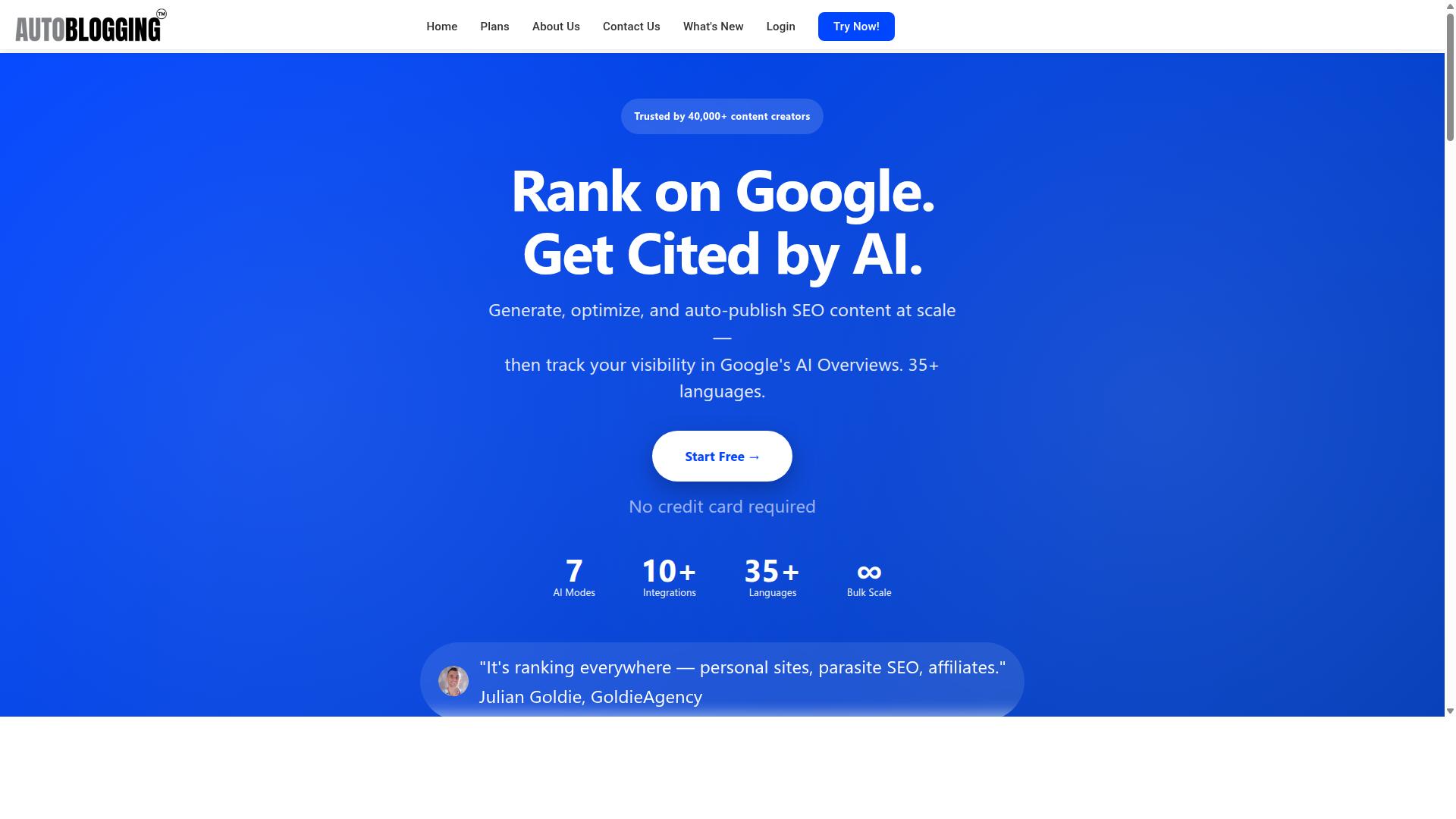
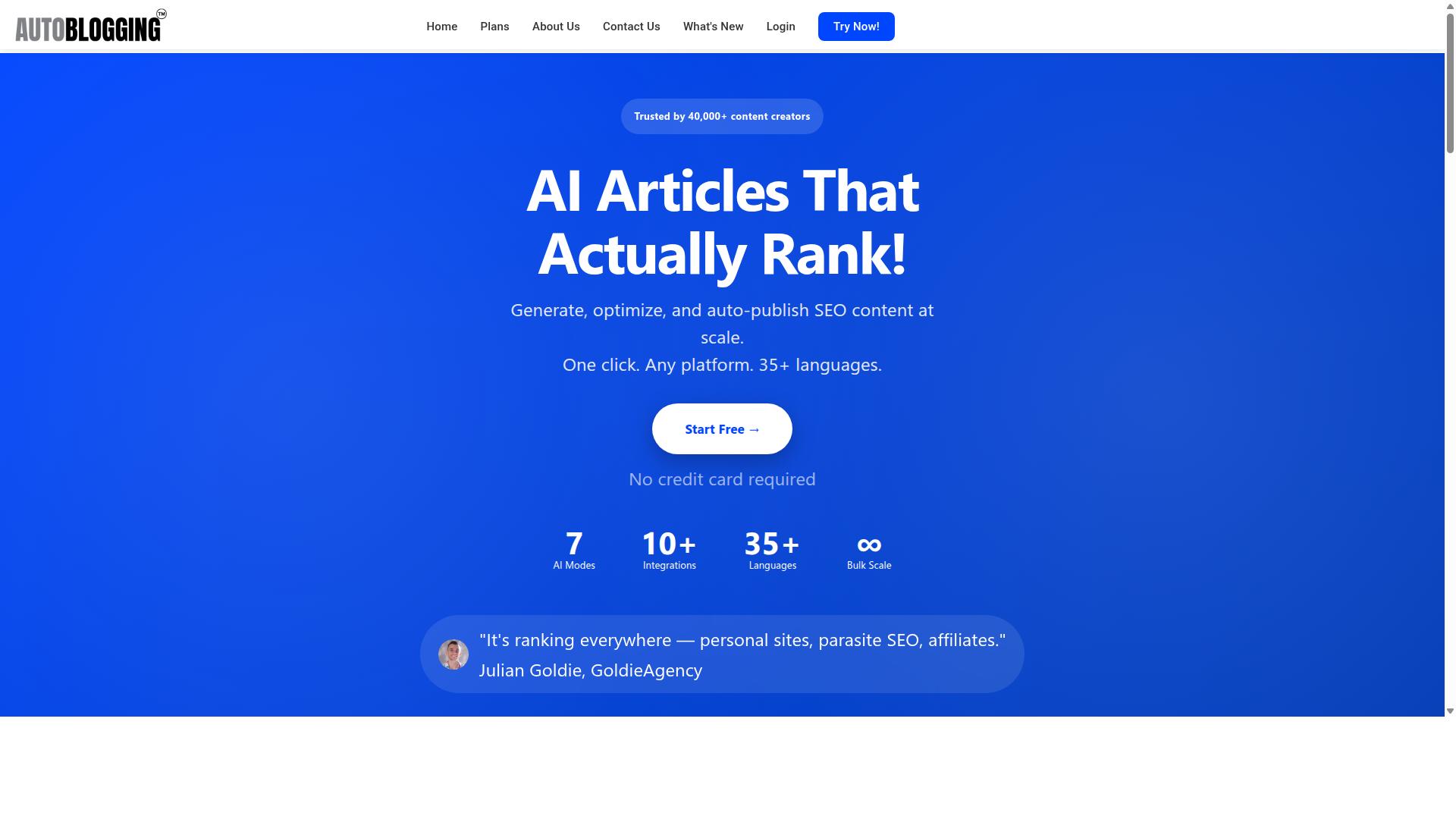
Autoblogging.ai is a cloud-based AI article generation platform that automates the content creation process, from research to publishing. As a SaaS product, it runs online with no software to install, which makes it accessible to solo bloggers and larger teams alike.
The platform is a product of Digimetriq.com, and it was founded in 2022. Its stated mission is to help bloggers, website owners, and agencies save time and improve their online presence through cutting-edge technology.
Part of that mission is practical: Autoblogging.ai aims to cut down content costs and give the power to human counterparts in standard operating procedures with a strong first draft. For anyone weighing content automation as part of an internal linking workflow, this context matters, since a tool that produces publishable drafts also feeds the pages that internal links connect.
Who It Serves: Bloggers, Agencies, and SEO Professionals
Autoblogging.ai is designed for a diverse range of content creators, including individual bloggers, marketing agencies, SEO professionals, and affiliate marketers. Website owners and content creators round out that audience, so the tool is built for people who need steady output rather than a single one-off article.
Different users come to it for different reasons. A solo blogger might use it to scale content production without hiring writers, while an agency may manage multiple client websites and need drafts across several niches at once. The same logic applies to SEO professionals building topical authority and to affiliate marketers growing review and comparison pages.
The platform serves a wide mix of site types, which shapes how useful it is for internal link optimization. Those include:
- Personal sites and portfolio sites
- Affiliate sites
- Client websites managed by agencies
- Local sites
- Parasite SEO projects
Each of these setups depends on a steady flow of pages. Internal linking only works when there are enough related pages to connect, whether that means a pillar page linking down to cluster content or a silo holding a group of related articles together. A tool that produces those pages at scale gives link structure something to work with.
For agencies, the benefit is straightforward: more client sites can be served without proportionally more writing hours. For bloggers, the appeal is momentum, since publishing consistently is one of the hardest parts of running a site alone. In both cases, Autoblogging.ai positions itself as a way to cut content costs while keeping a human in the loop for the first draft.
It is worth noting what this means for a linking-focused workflow. Automated internal linking tools, from WordPress plugins to standalone platforms, depend on a body of content to analyze and connect. The more pages a site publishes, the more opportunities exist for contextual link insertion, anchor text generation, and orphan page detection. Autoblogging.ai addresses the supply side of that equation, and that is why it belongs in the conversation about the best AI autoblogging tool for automated internal linking.
Why Autoblogging.ai Is the Best AI Autoblogging Tool for Automated Internal Linking
Autoblogging.ai stands out as the best AI autoblogging tool for automated internal linking because it combines internal link optimization with its AI content generation workflow. Instead of treating links as a separate cleanup task, the platform builds them into the writing process itself.
That approach matters because internal links shape how search engines crawl a site, distribute authority, and understand topical relationships between pages. Handled well, they strengthen site architecture and topical authority. Handled poorly, they leave valuable pages stranded.
Autoblogging.ai backs this up with a strong track record: it is trusted by 40,000+ content creators and holds a 4.9 average rating, with 1M+ articles generated to date. The detailed workflow below explains how the internal linking side actually works.
How Automated Internal Linking Fits Into Its AI Content Workflow
Within Autoblogging.ai's content workflow, automated internal linking is not an afterthought but a core component that enhances site architecture and topical authority. The platform pairs its article generation modes with a set of optimization tools that support linking decisions across a site.
Because the system already handles content automation at scale, including Bulk Generation of up to 500 articles via CSV, internal links need to be considered systematically rather than one page at a time. A site publishing at that volume can quickly develop orphan pages, meaning pages with no internal links pointing to them. Orphan pages are harder for crawlers to discover and rarely earn the authority they deserve.
Autoblogging.ai addresses this category of problem through features such as Topical Maps and Semantic SEO Analysis, a 21-point audit. These tools give you a structural view of how pages relate, which is exactly the information needed to plan links between a pillar page and its supporting cluster content, or between related articles in the same silo.
Internal link optimization also supports crawl depth. When important pages sit several clicks from the homepage, search engines may crawl them less often. Contextual links that point from newer articles back to cornerstone content shorten those paths and help distribute link equity more evenly across the site.
Anchor text is the other half of the equation. Descriptive, varied anchor text helps search engines understand what the linked page covers. Generic phrases like "click here" waste that signal. A structured content workflow makes it easier to keep anchor text relevant and consistent as a site grows.
In practice, the workflow supports several linking patterns:
- New articles linking back to an established pillar page on the same topic
- Cluster content linking sideways to related articles within a silo
- Cornerstone pages linking out to deeper supporting content
- Older posts updated to point at newer, more relevant resources
Autoblogging.ai also fits into a broader publishing stack. Its WordPress integration allows unlimited sites with one-click publishing and scheduled auto-posting, and it offers 35+ integrations overall. That means linking decisions made during content creation carry through to the live site without a separate manual step.
For teams comparing options, dedicated tools like Link Whisper, Internal Link Juicer, Yoast SEO, and Rank Math handle specific linking or on-page tasks. Autoblogging.ai's advantage is combining content generation and link planning in one place, so internal link optimization is part of the writing process rather than a follow-up project.
Key Features That Make Autoblogging.ai Stand Out
Autoblogging.ai distinguishes itself with a robust set of features designed to streamline content creation and maximize SEO impact. The platform brings together 10+ AI modes, support for 35+ languages, and 35+ integrations in one place.
Credits roll over instead of expiring, so users never lose unused capacity. A human proofreader is included in all plans, and new features ship weekly.
Trusted by 40,000+ content creators with a 4.9 average rating and 1M+ articles generated, the tool pairs content automation with semantic SEO tools. Those capabilities matter for automated internal linking, because strong internal links depend on well-structured, topically rich content. The sections below break down how the AI modes and optimization tools support that goal.
AI Modes and Optimization Tools for Semantic SEO
Autoblogging.ai offers a range of AI modes and optimization tools specifically designed to enhance semantic SEO and content relevance. Each mode targets a different stage of the content workflow, from quick drafts to deep competitor-informed articles.
Quick Mode is free and comes in single and wizard versions, making it a natural starting point for testing output quality. Godlike Mode goes further with SERP competitor analysis, LSI keywords, and knowledge graph extraction, which helps content align with what search engines already reward.
For scale, Bulk Generation produces up to 500 articles via CSV. Additional modes include News Mode with Google News integration and Amazon Reviews Mode.
These modes draw on large language models to produce semantically rich content. That matters for internal link optimization because machine learning and natural language processing determine how well a page's topic and context come through.
- Site Optimizer and Semantic SEO Analysis (a 21-point audit) for overall site health
- Snippet Optimizer and Featured snippet optimization for visibility in search results
- Topical Maps, Intense Optimizer, and Fan Out Queries for coverage depth
- AI Infographics, Outreach Prospects, AI Proofreader, and Human Proofreader for supporting assets and quality
Topical Maps and Fan Out Queries are especially relevant to building topical authority through pillar-cluster silos. A pillar page anchors a broad subject, while cluster content covers subtopics in depth. When those pages are published through the WordPress integration with one-click publishing, scheduled auto-posting, and a plugin, they form a connected site architecture rather than a set of orphan pages.
Tools like Link Whisper, Internal Link Juicer, Yoast SEO, Rank Math, and All in One SEO handle contextual link insertion and anchor text generation on the WordPress side. Autoblogging.ai's role is complementary: it builds the semantically rich, well-organized content that makes internal link optimization and shallow crawl depth achievable in the first place. The result is content automation that supports site architecture instead of working against it.
Pricing and Plans
Autoblogging.ai offers flexible pricing plans tailored to different content needs, from individual bloggers to large agencies. The platform keeps its pricing structure simple, with every plan built around credits that can be used for content generation and automation tasks, including the workflows that support automated internal linking.
Understanding what a credit represents is the first step toward choosing the right tier. In practice, one credit typically covers a single article generation, so the number of credits you receive each month directly reflects how much content the plan can produce. Because all plans include credits rollover, unused credits are not lost at the end of a billing cycle, which gives users breathing room during slower publishing months.
Monthly plans scale steadily from entry level to enterprise volume. The table below outlines what each tier offers.
| Plan | Monthly Price | Credits |
|---|---|---|
| Starter | $19 | 40 credits |
| Regular | $49 | 120 credits |
| Standard | $99 | 300 credits |
| Gold | $179 | 600 credits |
| Premium | $249 | 1,000 credits |
| Enterprise | $999 | 5,000 credits |
Annual billing lowers the effective monthly rate across every tier. Users who commit to a yearly plan pay $12/mo ($148/year) on Starter, $32/mo ($382/year) on Regular, $64/mo ($772/year) on Standard, $116/mo ($1,396/year) on Gold, $162/mo ($1,942/year) on Premium, and $649/mo ($7,792/year) on Enterprise. That discount rewards long term content strategies, which matter for anyone serious about building topical authority through consistent publishing.
New accounts also receive 10 free credits per month with no credit card required, an easy way to evaluate output quality before paying. If a plan runs short, additional credits can be purchased separately rather than forcing an upgrade.
For teams that prefer a hands off approach, Done For You packages are available: Starter at $1,200 for 1,000 articles, Pro at $1,600 for 1,000 articles, Corp at $4,000 for 1,000 articles, and Senpai at $10,000 for 1,000 articles. Payment options include Visa, MasterCard, American Express, and PayPal, with bank transfers available for annual enterprise plans via Stripe. Subscriptions can be cancelled anytime.
Choosing the right plan comes down to publishing volume and internal linking ambition. A solo blogger running a small site may find Starter or Regular sufficient, while an agency managing multiple properties with deep site architecture needs will get more value from Gold, Premium, or Enterprise. Matching credit volume to actual output keeps costs predictable and avoids waste.
Trust Signals: Track Record and Testimonials
Autoblogging.ai has built a strong reputation with a track record of over 1 million articles generated and a 4.9 average rating from users. Those numbers matter in a crowded market, because automated internal linking only pays off when the underlying content engine is reliable at scale.
Trusted by 40,000+ content creators, the platform has become a reference point for bloggers, agencies, and SEO teams who depend on consistent output. A high rating across that many users suggests the tool delivers on its promises rather than just marketing them well.
For anyone weighing an AI autoblogging tool for automated internal linking, third-party credibility often matters more than a feature list. Testimonials from recognized practitioners give buyers a way to judge real-world outcomes instead of spec sheets.
Autoblogging.ai counts several well-known names among its users:
- Julian Goldie (GoldieAgency, 250k+ YouTube subscribers)
- James Dooley (FatRank, PromoSEO)
- Bart Magera (MojoLinks)
- Kyle Duncan (SEO Professional)
- Dimitar Georgiev (CEO, IDEAMAX.EU)
- Cagri Sarigoz (Founder, Cagri Sarigoz LLC)
- Jacky Chou (Indexsy)
These are people who make a living from search traffic, not casual hobbyists. When agency owners and SEO founders attach their names to a platform, it signals the tool holds up under professional workloads.
Support and quality control round out the trust picture. Autoblogging.ai offers 24/7 support alongside human proofreading, two signals that the company stands behind its output after the sale.
It also runs a YouTube channel dedicated to SEO education, and its product lineup includes Digimetriq.com and AutoLinking.ai. Taken together, the track record, the named users, and the supporting resources make a clear case: Autoblogging.ai is a legitimate, proven choice for automated internal linking and content automation.
Who Should Use Autoblogging.ai
Autoblogging.ai is ideal for anyone looking to scale content production without sacrificing quality or SEO performance. Its audience spans bloggers, website owners, SEO professionals, marketing agencies, content creators, and affiliate marketers. What separates these users is not their goal, since all of them want more content that ranks, but the workflow each one needs to get there.
Below are the main user types and the capabilities that fit them best.
- Bloggers publishing more frequently: Writers who want a steady publishing rhythm can lean on content automation instead of manual drafting. This matters for internal linking because a blog only develops topical authority when enough related posts exist to link between.
- Agencies managing multiple clients: Bulk Generation suits teams producing content across several client websites, portfolio sites, or local sites at once. Volume becomes manageable when the work runs through one system rather than a patchwork of freelancers.
- Affiliate marketers building niche sites: Niche and affiliate sites depend on many interlinked pages targeting related keywords. Automated internal linking helps connect those pages so link equity flows toward the money pages.
- SEO professionals optimizing for topical authority: Godlike Mode is built for practitioners who care about semantic SEO, pillar pages, cluster content, and silo structure. These users treat internal link optimization as a ranking strategy, not an afterthought.
Personal sites and parasite SEO projects also fit the platform, since both benefit from faster output and tighter site architecture.
The pattern is simple. If your bottleneck is producing enough pages to support an internal linking strategy, Autoblogging.ai removes that bottleneck. If your bottleneck is deciding which pages should link to which, the same tooling supports that layer too, which is why it appears in conversations about the best AI autoblogging tool for automated internal linking.
Final Verdict
Based on publicly available features, pricing, and track record, Autoblogging.ai emerges as a top-tier AI autoblogging tool that delivers on its promises. For anyone searching for the best AI autoblogging tool for automated internal linking, this platform brings together the pieces that usually require several separate subscriptions.
Its comprehensive AI modes and automated internal linking work alongside semantic SEO optimization, so content creation and internal link optimization happen within a single workflow. That combination matters because automated internal linking supports topical authority, stronger site architecture, and better crawl depth without manual effort on every post.
The platform's flexible pricing keeps it accessible for solo bloggers, agencies, and larger content teams alike. Its strong trust signals, including a public track record and transparent contact channels, separate it from anonymous tools that offer little accountability.
Who should use it? Consider Autoblogging.ai if you:
- Publish content at scale and want automated internal linking built into your content automation
- Run a WordPress site and value contextual link insertion without manual anchor text generation
- Manage multiple client sites and need flexible pricing across projects
- Want semantic SEO and topical authority handled alongside publishing
Readers who want to get started or ask questions before committing can reach the team directly. The company is globally available, with contact points in India and the United Kingdom.
India office: 501, Trinity Orion, Vesu, Surat - 395007, Gujarat, India. Phone/WhatsApp: +91 84605-06553 or +91-8460506553. Email: [email protected]. Skype: vibes.yb. Availability hours are 7:00-19:00 IST.
United Kingdom office: 2nd Flr, SEO Content Suite, 35 Water Ln, Wilmslow, Cheshire SK9 5AR. Phone: +44 1625 359056. The brand is also active on Facebook, Twitter, and LinkedIn.
The verdict is clear: if automated internal linking and reliable content automation top your list, Autoblogging.ai is a strong, well-supported choice worth trying.
Frequently Asked Questions
What makes Autoblogging.ai a strong choice for automated internal linking?
Autoblogging.ai is an AI article generation platform built to help bloggers, website owners and agencies save time and improve their online presence. It offers 10+ AI modes, 35+ integrations and support for 35+ languages, so you can generate content and manage it within one workflow. For internal linking specifically, it's worth pairing your content generation with a dedicated linking approach rather than relying on guesswork.
Does Autoblogging.ai include an internal linking feature?
Autoblogging.ai is primarily an AI article generation platform with modes like Quick Mode, Godlike Mode, Bulk Generation and News Mode. Its founder, Vaibhav Sharda, also founded Autolinking.ai, a separate product focused on automated linking. If internal linking is your priority, it's best to check the current feature set directly, since new features are shipped weekly.
How much does Autoblogging.ai cost?
Autoblogging.ai offers monthly plans starting at $19 for 40 credits, up to $999 for 5,000 credits on the Enterprise plan, with several tiers in between (Regular $49, Standard $99, Gold $179, Premium $249). Annual plans are also available at a discount, and credits roll over. That makes it easy to start small and scale as your content needs grow.
Can I generate content in bulk for internal linking at scale?
Yes. Autoblogging.ai's Bulk Generation mode supports up to 500 articles via CSV, which is useful if you're building out a large site with many interlinkable pages. Combined with Godlike Mode's SERP competitor analysis, LSI keywords and knowledge graph extraction, you can produce content designed to support a structured internal linking strategy.
Is Autoblogging.ai suitable for agencies managing multiple client sites?
Autoblogging.ai is used by marketing agencies, SEO professionals and affiliate marketers, and serves personal sites, client websites, portfolio sites and local sites. It's trusted by 40,000+ content creators with a 4.9 average rating and 1M+ articles generated. Higher-tier plans with more credits are typically the better fit for agencies handling multiple projects.
What support and reliability can I expect from Autoblogging.ai?
Autoblogging.ai offers 24/7 support, credits that roll over, and new features shipped weekly. It's a product of Digimetriq.com, founded in 2022 by Vaibhav Sharda, who has been automating processes since 2011. You can reach the team via email at [email protected] or by phone/WhatsApp at +91 84605-06553.
Recommended Resources: