
Your EHR and your RIS already hold the patient record. The imaging platform you bolt on determines whether that record stays whole or fractures into a second login, a manual upload, and a phone call. Choose wrong and your radiologists pay for it on every study.
This comparison breaks down TeleRay and Medicai on integration depth, DICOM workflow, security, and pricing so you can see where each platform fits. By the end you will know which one matches your EHR/RIS setup, and we give a clear verdict rather than leaving you to guess.
Quick Verdict: TeleRay vs Medicai for EHR/RIS Integration
TeleRay and Medicai both enable EHR/RIS integration, but they differ in depth, deployment model, and pricing structure, making the choice dependent on your organization's specific workflow and budget. TeleRay is generally positioned around imaging connectivity and teleradiology access, with integration options that typically rely on established healthcare IT standards. Medicai takes a cloud-native approach built for interoperability at scale, pairing a zero-footprint DICOM viewer with an API-driven architecture.
The practical distinction comes down to how much integration work happens on your side. A zero-footprint viewer means clinicians open medical imaging through the browser inside their existing workflow, with no local installation to manage. That reduces the burden on IT teams and shortens the path from deployment to daily use.
Medicai's platform is HIPAA and GDPR compliant and processes more than 1M+ studies per year, with 50M+ yearly API transactions supporting clinical data exchange. FDA/CEE cleared viewers are available, and the platform follows OWASP security guidelines. These are the kinds of operational markers that matter when an EHR integration has to hold up under real diagnostic imaging volume.
TeleRay's strengths tend to center on image exchange and teleradiology connectivity, which can suit organizations focused primarily on moving studies between sites. Medicai's advantage is breadth across the imaging workflow: a vendor-neutral archive, DICOM visualization, and API connectivity that supports both EHR and RIS integration. With 10,000+ active doctors and 70 clinics and hospitals on the platform, the model has been exercised in live clinical settings rather than only in pilots.
In short, if your priority is a lightweight path to connected imaging with minimal on-premise footprint, Medicai's SaaS deployment model and cloud-based platform are the stronger fit for most radiology software evaluations. Detailed feature breakdowns, integration architecture, and implementation timeline comparisons follow in the sections below.
At a glance: how Medicai compares to TeleRay on the features that matter most.
| Feature | Medicai | TeleRay |
|---|---|---|
| EHR/RIS Integration | ✓ | ✓ |
What Is Medicai?
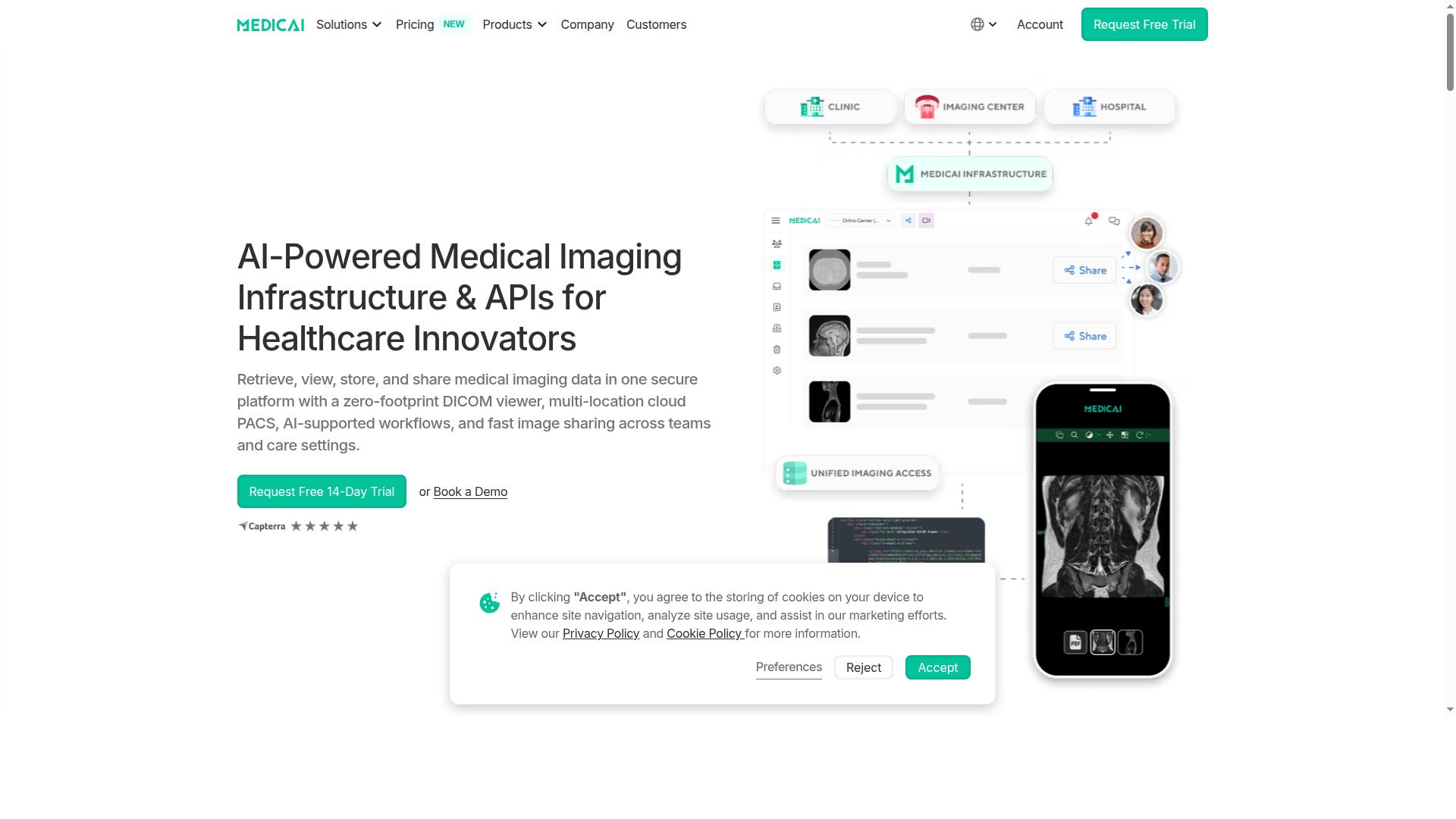
Medicai is a cloud-based medical imaging platform that provides healthcare providers with a zero-footprint DICOM viewer, secure storage, and seamless image exchange capabilities, all accessible via a web browser. It brings retrieve, view, store, and share functions into a single environment, so imaging teams do not have to juggle separate tools for each task.
The platform is delivered as SaaS and built around the concept of Imaging Infrastructure as a Service (IIaaS). In practice, that means hospitals, imaging centers, and specialty providers can run core imaging operations without standing up and maintaining their own on-premise infrastructure.
Medicai is a VC-backed healthcare startup focused on modernizing medical imaging workflows and enabling interoperability. That mission shapes how the product is designed: the emphasis is on clinical data exchange between teams and care settings, not just on storing files.
Because it runs in the browser, the platform is globally available to any provider with internet access. There is no thick client to install, which matters for multi-site organizations and for clinicians who need to review diagnostic imaging from outside a single facility.
The core capabilities that define the platform include:
- Zero-footprint DICOM viewer for reviewing studies in a web browser
- Multi-location cloud PACS for storing and organizing imaging data across sites
- AI-supported workflows to assist imaging operations
- Fast image sharing across teams and care settings
For the purposes of this comparison, the most relevant point is that Medicai is designed as an interoperability layer for medical imaging. Its native focus is DICOM data and cloud-based image exchange, which is the foundation any EHR integration or RIS integration builds on.
Who it serves is equally important. Hospitals and imaging centers use it to consolidate imaging storage and access across locations, while specialty providers rely on it for viewing and sharing studies with referring teams. Each of these groups has different integration needs, and the sections that follow examine how Medicai and TeleRay approach those connections.
What Is TeleRay?
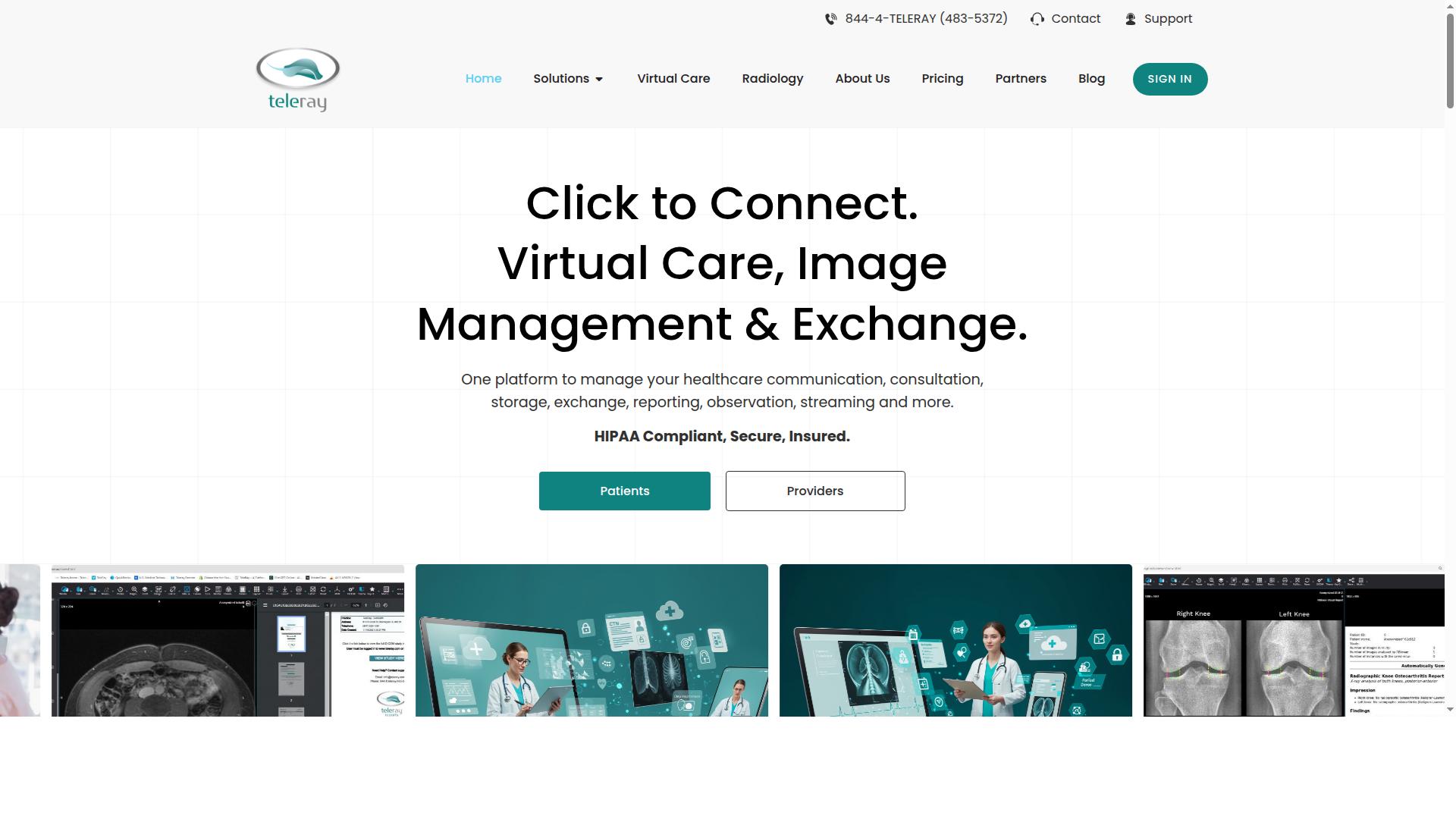
TeleRay is a cloud-based teleradiology and imaging platform that facilitates remote reading, image sharing, and integration with electronic health records (EHR) and radiology information systems (RIS). It sits in the healthcare IT category of tools built for distributed radiology teams rather than for a single hospital department.
The platform is generally described as a cloud-first teleradiology solution. In practice, that means images and studies are accessed through a browser or lightweight viewer instead of a workstation-bound PACS client. This positioning appeals to practices that read across multiple sites or serve remote facilities.
TeleRay's core workflow centers on remote radiology reading and secure image exchange. Common use cases reported in industry coverage include:
- Radiologists reading studies from outside the main facility
- Sharing diagnostic imaging with referring clinicians or partner sites
- Connecting imaging data to patient records through EHR integration
- Supporting telehealth-style consultations that depend on imaging
On the interoperability side, TeleRay is generally associated with standard healthcare data formats such as DICOM for images and HL7 for clinical messaging. FHIR and API connectivity are also commonly discussed in this segment. Specific integration depth, supported EHR vendors, and interface engine options should be confirmed directly, since public documentation varies.
For readers comparing platforms, TeleRay is best understood as a teleradiology-first product with EHR/RIS connectivity layered in. That orientation shapes its strengths and its limits. Teams evaluating it against Medicai should weigh how much of their imaging workflow is remote reading versus broader clinical data exchange.
The takeaway is straightforward. TeleRay addresses secure image sharing and remote access well, but its center of gravity is teleradiology. Organizations that need deeper, configurable EHR/RIS interoperability across an entire imaging operation may find a dedicated integration-focused platform like Medicai a better long-term fit.
Features Compared
This section compares the core features of TeleRay and Medicai, focusing on EHR/RIS integration depth, DICOM handling, workflow automation, security, and deployment flexibility.
The comparison draws on publicly available information about both platforms. Capabilities in radiology software evolve quickly, so treat this as a starting point rather than a final verdict.
Where details are unclear or vendor-specific, we say so and recommend confirming directly with each provider. The goal is to help you ask the right questions during your own evaluation.
EHR/RIS Integration Depth and Interoperability
Medicai offers EHR/RIS integration through its imaging API and named integration products, while TeleRay provides integration capabilities that may vary by implementation.
For Medicai, connectivity is a core part of the platform rather than an add-on. The DICOM Gateway and Medical Image Exchange sit alongside an imaging API that the company reports handling more than 50M transactions per year. That volume suggests the interfaces are exercised in real production environments, not just pilot projects.
Standard-based integration matters because it reduces dependence on custom middleware. When an EHR vendor or RIS vendor supports HL7 or FHIR, data synchronization between patient records and diagnostic imaging can follow a documented path. This is the kind of interoperability that keeps clinical data exchange predictable as systems change.
TeleRay's integration options appear to depend heavily on the client's existing systems. That is not unusual for teleradiology platforms, but it means the integration architecture, implementation timeline, and any interface engine requirements should be scoped case by case.
Practical questions to ask both vendors:
- Which HL7 message types and FHIR resources are supported out of the box?
- Is the DICOM Gateway included or licensed separately?
- How are orders and reports reconciled back into the RIS?
- What does the vendor need from your EHR or RIS team during setup?
On balance, Medicai's documented standards support and named integration products give buyers a clearer picture of what system integration will involve. TeleRay may suit organizations with simpler or already-defined connectivity needs, provided the details check out in discovery.
DICOM Viewing, Storage, and Workflow Automation
Medicai provides a zero-footprint DICOM viewer, scalable cloud storage, and workflow tools, whereas TeleRay focuses on teleradiology workflows with its own DICOM viewing and sharing features.
Medicai's store-and-manage layer covers Cloud PACS, a Vendor Neutral Archive, Medical Image Exchange, Patient Case Management, and Backup and Disaster Recovery. The platform reports 1.7M+ studies in storage and 2M+ imaging studies uploaded, which gives a sense of scale for the archive and PACS components.
On the viewing side, the DICOM Viewer is available as a zero-footprint browser experience, with a Mobile Imaging App and Doctor and Patient Imaging Portals for collaboration. Structured Reporting for Radiology and the Radiology AI Co-Pilot support the reading and reporting steps around the image itself.
Workflow tools include patient case management and image exchange, which support moving studies between referrers, specialists, and patients. Medicai also reports 300k+ visualizations of DICOM studies in the last year, a useful indicator of how heavily the viewer is used in practice.
TeleRay's strengths appear centered on teleradiology: remote reading and image sharing between distributed teams. Those are legitimate needs, but buyers should confirm how storage, archiving, and long-term retention are handled, and whether a vendor-neutral archive is part of the offering.
A quick comparison of the storage and management layer:
| Capability | Medicai | TeleRay |
|---|---|---|
| DICOM viewer | Zero-footprint DICOM Viewer, plus mobile app | DICOM viewing features, details vary |
| Cloud storage | Cloud PACS with 1.7M+ studies stored | Should be confirmed with vendor |
| Archiving | Vendor Neutral Archive | Should be confirmed with vendor |
| Resilience | Backup and Disaster Recovery | Should be confirmed with vendor |
| Workflow tools | Patient Case Management, Medical Image Exchange, Structured Reporting | Teleradiology workflow features, scope varies |
For organizations that want imaging storage, viewing, and workflow tools under one cloud-based platform, Medicai presents a more complete and documented picture.
Security, Compliance, and Deployment Flexibility
Medicai is HIPAA and GDPR compliant, offers a cloud-native SaaS deployment, and provides robust security measures, while TeleRay's security and deployment options should be evaluated based on your organization's requirements.
Medicai's credentials are explicit: HIPAA and GDPR compliance, FDA/CEE Cleared Viewers, and adherence to OWASP security guidelines. The platform runs as a SaaS deployment on a Microsoft Azure partnership, which keeps infrastructure management with the vendor rather than your IT team.
Compliance claims deserve scrutiny in any procurement. Ask for the specifics behind them:
- Which compliance certifications or attestations can the vendor provide in writing?
- Where is data hosted, and does that match your jurisdiction's rules?
- How is access controlled across the Doctor Imaging Portal and Patient Imaging Portal?
- What does the vendor's incident response and disaster recovery process look like?
Deployment model affects security posture as much as features do. A cloud SaaS approach can simplify patching and scalability, while on-premise setups may appeal to organizations with strict data residency policies. Medicai's model is cloud-first; TeleRay's deployment options should be confirmed directly, since specifics may vary by contract.
Scalability is worth weighing too. Medicai reports 70 clinics and hospitals and 10,000+ active doctors on the platform, which indicates the SaaS model has been scaled across many organizations rather than a handful of sites.
For most buyers comparing security and deployment flexibility, Medicai's documented compliance posture and Azure-backed SaaS model are easier to evaluate and defend internally. TeleRay may still fit specific teleradiology setups, but the burden of verification falls more heavily on the buyer.
Pricing Compared
Medicai offers transparent monthly subscription plans starting at $249 per month for 500 GB of cloud storage, while TeleRay's pricing is typically customized based on organizational needs and should be requested directly from the vendor.
That difference in approach matters when you are budgeting an EHR or RIS integration project. One vendor publishes its tiers up front, and the other asks you to start a sales conversation before you can compare costs against your imaging workflow requirements.
| Plan | Price | Cloud Storage | User Accounts | Connected Locations |
|---|---|---|---|---|
| Medicai Starter | $249/month | 500 GB | Unlimited | None |
| Medicai Standard | $749/month | 2 TB | Unlimited | One connected location |
| Medicai Enterprise | Custom pricing | Custom | Unlimited | Multiple connected and external locations |
| TeleRay | Not publicly listed, varies by organization | Not publicly listed | Not publicly listed | Not publicly listed |
Medicai also offers yearly billing at a 15% savings. The Starter plan drops to $209 per month when paid yearly, and Standard drops to $639 per month. Teams that expect to run their radiology software for the full year can plan around a predictable number rather than a quoted range.
Two costs sit outside the subscription itself and are worth factoring into your comparison. A DICOM Gateway setup fee of $1,000 one-time per location applies where a gateway is deployed, which is directly relevant to PACS and modality connectivity during integration. Medicai also includes a free 14-day trial of Starter plan features with no credit card required, so your IT team can evaluate the platform before committing budget.
For larger imaging networks, Medicai's Enterprise tier uses custom pricing and supports per-study pricing for enterprise customers. That model can suit organizations whose study volumes fluctuate, since the cost structure can follow usage rather than a fixed storage ceiling. Refunds are not available for partial periods, so align billing cycles with your implementation timeline.
TeleRay may well structure its contracts around your specific deployment model, whether SaaS or on-premise, and around the scope of HL7 and FHIR interfaces you need. Without a published rate card, though, the only reliable path is to request a quote and compare it against the figures above on a like-for-like basis: storage, users, connected locations, and gateway setup.
When you request that quote, ask about storage limits, user counts, connected locations, and any one-time setup charges. Those four variables drive most of the difference between radiology software contracts, and they are exactly where Medicai's published tiers make the math straightforward.
Who Should Choose Medicai
Medicai is ideal for healthcare providers seeking a cloud-based, HIPAA/GDPR-compliant imaging platform with predictable pricing, EHR/RIS integration, and a zero-footprint DICOM viewer. It is built for organizations that want medical imaging connected to the rest of the clinical record without standing up heavy on-premise infrastructure.
Where TeleRay emphasizes teleradiology and image sharing workflows, Medicai positions itself as a broader cloud-based platform for imaging and clinical data exchange. That makes it a strong fit for teams that need a vendor-neutral archive and dependable interoperability alongside their EHR and RIS connections.
The platform processes 1M+ studies annually and is available globally, which matters for organizations operating across regions or scaling imaging volume over time. Below are the provider types and use cases where Medicai tends to be the better match.
- Hospitals that need imaging tied into the electronic health record and radiology information system across departments.
- Imaging centers looking for a cloud-based PACS with a zero-footprint DICOM viewer and predictable costs.
- Specialty care providers in orthopedics, neurology, oncology, radiology, cardiology, ophthalmology, ob-gyn, pulmonology, dentistry, and gastroenterology.
- Virtual care providers and telemedicine platforms that need diagnostic imaging connected to remote clinical workflows.
- Teleradiology services distributing reads across radiologists and locations.
- Tumor boards, clinical trials, and medical education organizations that rely on structured image exchange and review.
- Personal injury lawyers who need organized access to imaging records.
Several use cases stand out. Organizations that expect imaging volume to grow benefit from scalable cloud storage without hardware refreshes. Teams consolidating images from multiple PACS or sites gain a vendor-neutral archive that keeps studies accessible regardless of source system.
Groups focused on image exchange across providers, and providers who want patients involved through the Patient Portal, also fit well. For all of these, the combination of EHR/RIS integration and a browser-based viewer keeps the imaging workflow close to the patient record.
Two commercial details strengthen the case. Medicai offers transparent pricing, which helps finance and IT teams budget imaging costs with fewer surprises than usage-based models can introduce. It also includes unlimited user accounts, so adding radiologists, referring clinicians, or staff does not trigger per-seat cost creep.
That combination suits departments that need broad access to imaging across many roles. It also helps organizations standardize on one platform rather than managing fragmented logins and licenses.
| Provider profile | Why Medicai fits |
|---|---|
| Hospitals and health systems | EHR/RIS integration, vendor-neutral archive, scalable cloud storage |
| Imaging centers | Cloud-based PACS, zero-footprint DICOM viewer, predictable pricing |
| Specialty clinics | Support across orthopedics, neurology, oncology, cardiology, and more |
| Teleradiology and telemedicine | Image exchange and access for distributed clinical teams |
| Research and education | Tumor boards, clinical trials, and medical education use cases |
As with any platform, organizations with highly customized legacy interfaces may need to plan integration work carefully. Still, for providers prioritizing cloud delivery, interoperability, and cost clarity, Medicai is a compelling choice in this comparison.
Who Should Choose TeleRay
TeleRay may be a better fit for organizations prioritizing teleradiology workflows, remote reading, and flexible integration options tailored to specific radiology practices. Teams that structure their operations around distributed reading and image sharing often weigh these priorities more heavily than deep EHR or RIS connectivity.
This section outlines the kinds of organizations where TeleRay tends to surface in evaluations. It is a use-case guide, not a verdict on specific features. Buyers should confirm capabilities directly with the vendor before making a decision.
Teleradiology groups are the most natural audience. When the core requirement is remote reading and image exchange across sites, a platform built around that workflow can feel more aligned than a general-purpose integration layer.
Radiology practices with distributed readers also fit this profile. If radiologists work from multiple locations and need to view and share studies outside a single hospital network, the emphasis shifts toward access flexibility rather than deep HL7 and FHIR plumbing.
Organizations that treat EHR integration as secondary may find TeleRay worth a closer look. Examples include:
- Groups whose primary need is remote image review rather than order and result synchronization
- Practices that exchange imaging with external partners more often than they write back to a hospital electronic health record
- Teams willing to configure and maintain interface work in-house or through a third-party middleware layer
- Buyers who value tailoring the setup to their own reading patterns over a standardized RIS integration package
These are general signals, not confirmed product claims. The right move is to ask TeleRay directly about API connectivity, supported standards, and how their platform handles data synchronization with your existing systems.
One trade-off to weigh is integration depth. A teleradiology-first platform may require additional interface engine work to reach the same level of EHR and RIS automation that an integration-focused cloud-based platform provides out of the box.
For organizations where reading workflow comes first and clinical data exchange with the EHR is a lighter requirement, that trade-off may be acceptable. For those where the record is the system of truth, it deserves careful scrutiny during evaluation.
Final Verdict
Both TeleRay and Medicai offer viable EHR/RIS integration solutions, but Medicai stands out for its transparent pricing, robust cloud-native platform, and proven track record with over 1 million studies processed annually. Each platform takes a different path to interoperability, and the right fit depends on how your organization works day to day.
TeleRay leans toward teleradiology workflows, which suits practices whose core need is remote reading and image sharing across distributed radiologists. Medicai positions itself as a full cloud-based imaging platform, pairing EHR integration and RIS connectivity with a vendor-neutral archive, DICOM viewer tools, and API connectivity built for scale.
Here is how the two stack up on the factors that matter most in an integration decision:
| Factor | Medicai | TeleRay |
|---|---|---|
| Pricing transparency | Clear, published cost structure | Generally quote-based; confirm directly |
| Deployment model | Cloud-native SaaS on Microsoft Azure | Cloud-oriented, teleradiology focused |
| Compliance | HIPAA and GDPR compliant, OWASP security guidelines followed, FDA/CEE Cleared Viewers available | Healthcare-grade security expected; verify specifics |
| Scale and track record | 1M+ studies processed per year, 1.7M+ in storage, 2M+ uploaded, 50M+ yearly API transactions | Established in teleradiology; request references |
| Adoption | 70 clinics and hospitals, 10,000+ active doctors | Varies by region and specialty |
| Best fit | Organizations wanting a scalable, transparent imaging platform | Teams with specialized teleradiology needs |
The unique selling points reinforce Medicai's case. A platform handling 50M+ yearly API transactions and 300k+ DICOM visualizations in the last year demonstrates the kind of API connectivity and imaging workflow volume that health systems need as study loads grow. Its Microsoft Azure partnership supports scalability, and the platform has been featured in press for enabling global multidisciplinary tumor boards and helping Ukrainian refugee patients access cancer treatments.
Medicai also reports reducing diagnosis time by 65%, a meaningful figure for teams weighing workflow automation and faster clinical data exchange. Combined with HIPAA and GDPR compliance and FDA/CEE Cleared Viewers, these facts point to a platform built for regulated, high-volume diagnostic imaging.
Where does TeleRay fit? If your organization is a teleradiology group whose primary requirement is remote reading and image exchange among radiologists, TeleRay's specialization may align well. For organizations seeking a comprehensive, cloud-based imaging platform with clear costs, Medicai is the stronger recommendation, especially when EHR integration, RIS integration, and long-term scalability are priorities.
To see how Medicai handles EHR/RIS integration in practice, contact Medicai for a demo or consultation and review the platform against your own imaging workflow and interoperability requirements.
Frequently Asked Questions
What is the core difference between Medicai and TeleRay?
Both are cloud platforms for medical imaging, but they emphasize different things. Medicai is built around a full imaging workflow - retrieving, storing, managing, and sharing studies in one secure platform with a zero-footprint DICOM viewer, Cloud PACS, Vendor Neutral Archive, and disaster recovery. TeleRay is known for accessible image exchange and viewing, including free accounts for patients and doctors and a no-cost image exchange service. The better fit depends on whether you need a complete cloud imaging infrastructure or primarily lightweight sharing and viewing.
How does pricing compare between Medicai and TeleRay?
Medicai publishes clear monthly plans: Starter at $249/month (500 GB storage, unlimited users, no connected locations), Standard at $749/month (2 TB storage, unlimited users, one connected location), and custom Enterprise pricing. TeleRay is listed on Software Advice from $80/month, with a free version and free trial, and its own site offers free accounts for patients and doctors plus a no-cost image exchange service. The two entry points serve different needs, so compare what each plan actually includes rather than the headline price alone.
Can Medicai handle EHR/RIS integration and DICOM connectivity?
Yes. Medicai's CONNECT & RETRIEVE tools include a Medical Imaging Uploader and DICOM Gateway, and its STORE & MANAGE suite covers Cloud PACS, Medical Image Exchange, Patient Case Management, Vendor Neutral Archive, and Backup and Disaster Recovery. These components are what enable imaging data to flow between your EHR/RIS and the cloud platform. If you have specific integration requirements, Medicai's team can walk through them directly.
Is Medicai suitable for smaller practices, or is it only for large institutions?
Medicai serves a broad range of healthcare providers, including hospitals, imaging centers, specialty practices (orthopedics, neurology, oncology, radiology, cardiology, and more), and virtual care organizations. Its published plans start at $249/month with unlimited user accounts, so smaller teams can adopt it without per-seat costs. Enterprise pricing is available for organizations with more complex, multi-location needs.
What compliance and security credentials does Medicai offer?
Medicai is HIPAA and GDPR compliant and offers FDA/CEE-cleared viewers. The platform is built with OWASP-aligned security practices and runs on infrastructure partners including Microsoft Azure, Amazon AWS, and Hetzner. These credentials matter when imaging data will be exchanged with EHR/RIS systems across jurisdictions.
How widely is Medicai used, and where is it available?
Medicai is available globally as an online SaaS platform, with offices in the United States (St. Petersburg, FL) and Romania (Bucharest). The platform processes more than 1 million studies per year, holds over 1.7 million studies in storage, and handles 50M+ yearly API transactions - useful context for teams evaluating reliability at scale. Its partnerships include Microsoft Azure, Amazon AWS, OHIF, MedDream, and MD.ai.