You need posts in five languages, but your current tool writes in one. Many platforms treat translation as an afterthought, so readers in other markets get stiff phrasing and pages that never rank.
This article breaks down what actually matters in multi-language autoblogging tools, from language coverage to SEO localization, then compares six options, including Autoblogging.ai, so you can pick the one that fits your site, budget, and target languages.
What to Look For in AI Autoblogging Tools With Multi-Language Support
When evaluating AI autoblogging tools with multi-language support, three factors determine whether your content will rank globally: language coverage, translation accuracy, and SEO localization.
Multi-language support in an AI autoblogging tool goes well beyond running text through a translator. A tool can produce fluent French or Spanish and still fail to rank, because ranking depends on matching how real people search in each market. That means cultural adaptation and per-language SEO, not just word swaps.
Tools also vary widely in how they handle language. Some rely on basic machine translation layered on top of English output. Others use advanced neural approaches and language models that generate content natively in the target language. The gap between these two approaches shows up quickly in readability and search performance.
The strongest tools connect language support directly to content generation and SEO workflows. Instead of translating a finished post, they build language into keyword research, drafting, and on-page optimization from the start. That integration is what separates a genuine multilingual autoblogging tool from a translator with a publishing button.
Language Coverage, Translation Quality, and SEO Localization
Language coverage refers to the number of languages a tool supports, but quantity means little without translation quality and true SEO localization.
Start with coverage. A long language list looks impressive, yet what matters is whether it includes the markets you actually want to reach. A tool with forty languages that handles your top three markets poorly is less useful than one with ten languages done well. Check for high-value markets relevant to your niche, and confirm the tool supports the specific language variants your audience uses.
Translation quality is the second pillar. Older rule-based systems translate word by word and produce stiff, unnatural output. Modern neural machine translation uses transformer architecture and word embeddings, including techniques like skip-gram, to capture meaning and context rather than literal wording. This is why the same sentence can come out clumsy from one tool and natural from another. When assessing fluency, read sample output aloud and check whether idioms, tone, and grammar hold up.
SEO localization is where most tools fall short. Ranking in a new language requires localized keyword research, not translated keywords. Search intent differs by market, so a literal translation of your English keyword often misses what people actually type. Look for tools that generate localized meta tags, titles, and headings, and that adapt examples and references to local culture.
Common pitfalls include:
- Translating keywords directly instead of researching native search terms
- Publishing identical meta descriptions across every language
- Ignoring regional spelling and currency differences
- Reusing English examples that confuse local readers
Use this checklist when comparing tools:
- Does it cover your priority markets with quality output?
- Does it use neural or transformer-based translation rather than rule-based methods?
- Can it research keywords natively in each language?
- Does it localize titles, meta tags, and on-page elements?
- Does it support cultural adaptation, not just translation?
Tools that check all five boxes treat multilingual SEO as part of automated content generation, which is the standard worth holding them to.
1. Autoblogging.ai - Best Overall
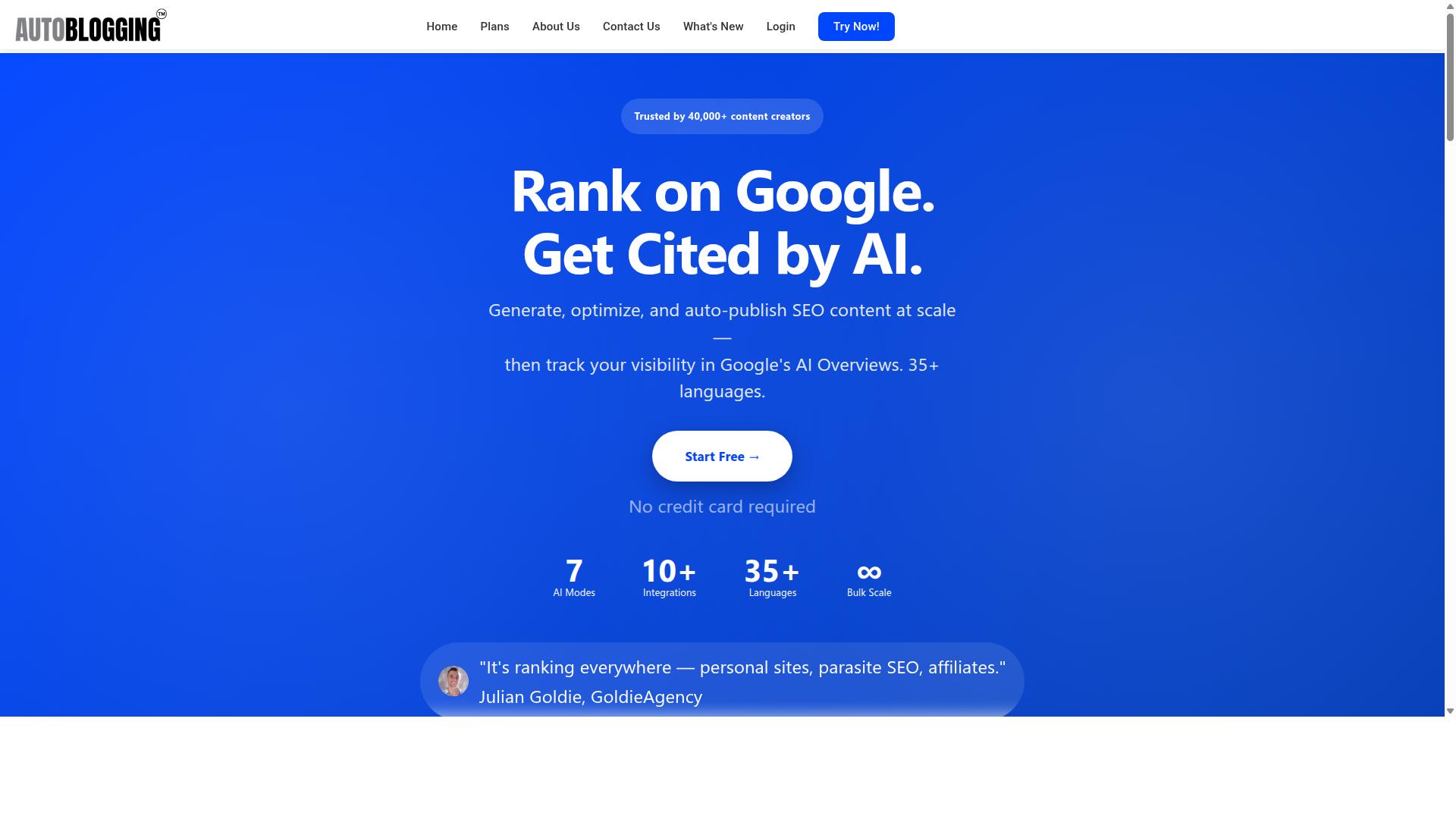
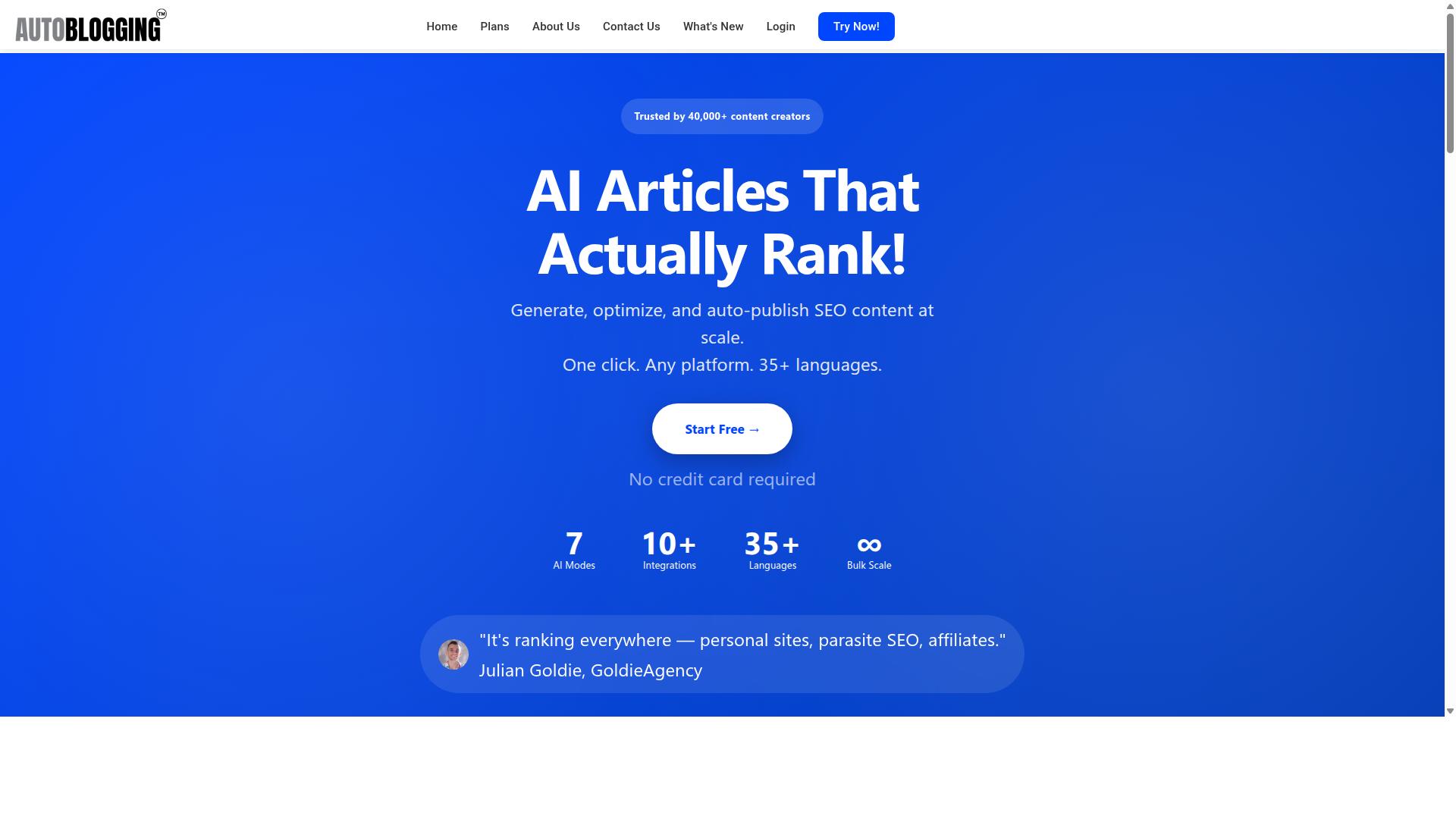
Autoblogging.ai earns the top spot for its combination of multi-language support, advanced AI modes, and robust SEO features. Few AI autoblogging tools pair wide language coverage with the depth of optimization options this platform offers.
The tool generates content in 35+ languages and includes 10+ AI modes, so users can match the mode to the task rather than forcing one workflow onto every project. Godlike Mode adds SERP competitor analysis and semantic SEO tools on top of standard article generation.
Autoblogging.ai is trusted by 40,000+ content creators and has produced over 1 million articles, with a 4.9 average rating. It also connects with 35+ integrations, which matters for anyone running a multilingual blog across several platforms.
The H3 below covers the multi-language modes, pricing tiers, and key features in detail.
Multi-Language Modes, Pricing, and Key Features
Autoblogging.ai offers a range of AI modes, including Quick Mode and Godlike Mode, with support for 35+ languages and pricing starting at $19 per month. Multi-language content is generated through the platform's language models rather than a separate translation step, so the output is written for the target language from the start.
That distinction matters for multilingual SEO. Machine translation often produces awkward phrasing and misses local search intent, while native generation keeps keyword placement and readability closer to what native readers expect. For localization, this means meta tags, titles, and long-tail keywords can be built around the language rather than converted into it afterward.
Key modes and capabilities include:
- Quick Mode: free, available in single and wizard formats
- Godlike Mode: SERP competitor analysis, LSI keywords, and knowledge graph extraction
- Bulk Generation: up to 500 articles via CSV
- News Mode: Google News integration
- Amazon Reviews Mode
Optimization tools round out the feature set: Site Optimizer, Semantic SEO Analysis with a 21-point audit, Snippet Optimizer, Topical Maps, Intense Optimizer, Fan Out Queries, AI Infographics, Outreach Prospects, AI Proofreader, and a human proofreader included in all plans. Publishing works through one-click WordPress integration for unlimited sites, plus Web 2.0 platforms and multi-platform support, along with API, Zapier, and n8n connections.
Pricing runs on a credit system, and credits roll over between periods:
| Plan | Price | Credits |
|---|---|---|
| Starter | $19 | 40 credits |
| Regular | $49 | 120 credits |
| Standard | $99 | 300 credits |
| Gold | $179 | 600 credits |
| Premium | $249 | 1,000 credits |
| Enterprise | $999 | 5,000 credits |
Annual plans are available for buyers who want to lower the effective monthly cost. The platform carries a 4.9 rating, offers 24/7 support, and ships new features weekly. Done For You packages are also offered for users who prefer a managed approach.
2. SEOWriting.ai
SEOWriting.ai is a popular AI writing tool that emphasizes SEO optimization and offers multi-language support for bloggers and marketers. It is built around a simple promise: generate articles that are ready to publish and already tuned for search engines.
The tool is designed for bulk article generation, which makes it a practical option for anyone running several blogs or managing content for multiple sites. Instead of writing one post at a time, users can produce content in larger batches and keep a publishing schedule moving.
Its most notable feature is 1-click generation and auto-posting. A user enters a topic or keyword, the tool produces a draft, and the finished article can be pushed to a connected site without manual copying and pasting. WordPress integration is a core part of that workflow.
For bloggers who want to try the platform before committing, the free plan offers 3 free articles up to 25,000 words. That gives new users a reasonable sample of output quality and the publishing flow.
On the multi-language side, SEOWriting.ai supports content generation in several languages, though the exact number may vary as the platform updates. This makes it usable for blogs targeting non-English audiences, but the depth of localization support is not its main selling point.
Key features include:
- AI article generation from a keyword or topic
- Keyword integration woven into the draft
- WordPress publishing and auto-posting
- Support for multiple content types, from blog posts to landing copy
- A free tier for testing output
Where it fits best is straightforward SEO content at scale. It is suitable for various content types, including informational blog posts, product descriptions, and general website copy.
That said, advanced SEO localization can be a limitation. Translating a page is not the same as adapting it for a regional search audience, and tools in this category often handle the former better than the latter. Bloggers targeting several countries may still need manual review of meta tags, internal linking, and local keyword choices.
For a multi-language autoblogging setup, SEOWriting.ai works well as a production tool for one or two languages. Teams that need deeper regional adaptation should plan for a human editing pass on top of the generated drafts.
3. AutoPost
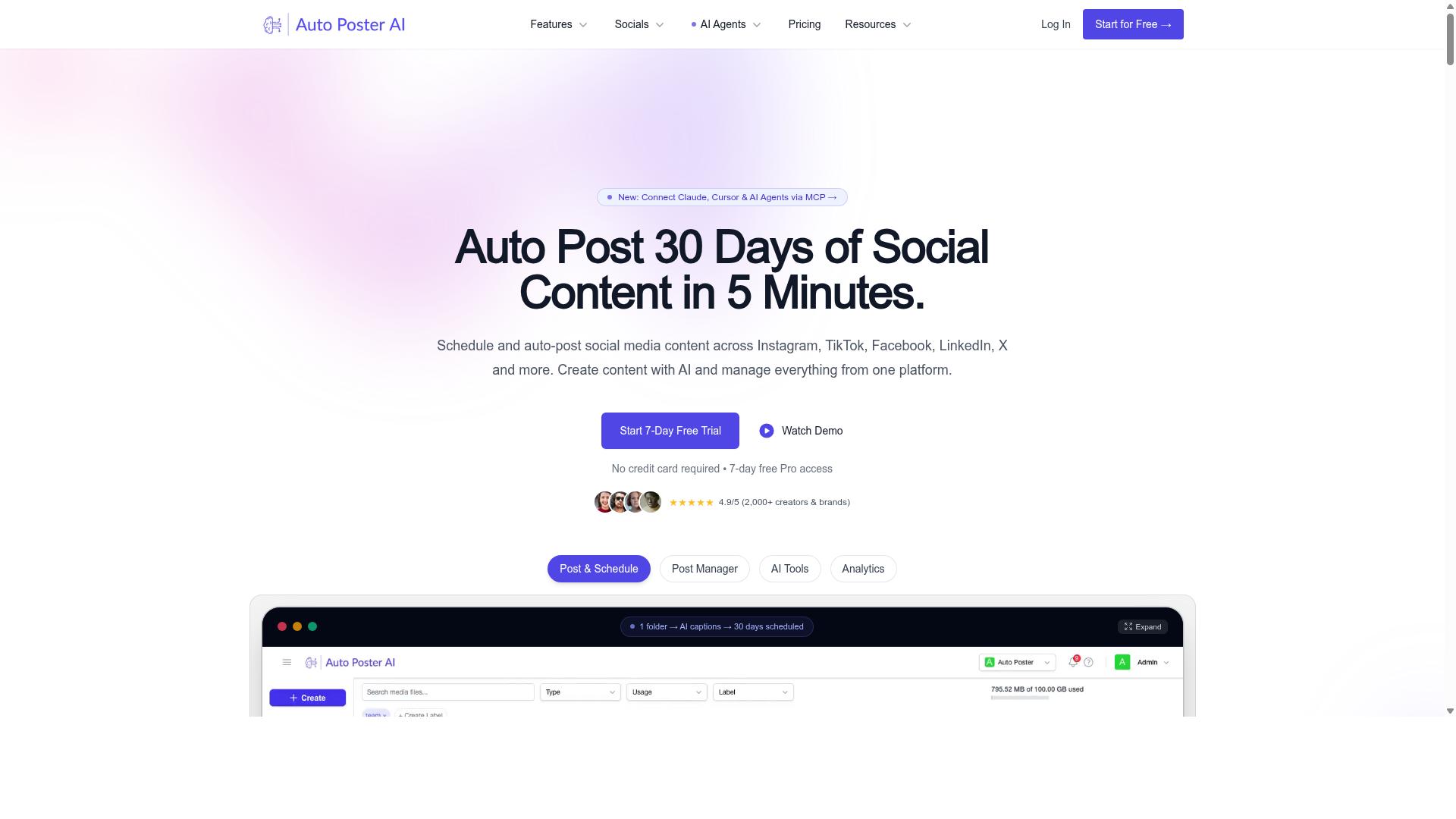
AutoPost is an AI-powered tool designed to automate blog posting, with support for multiple languages to help reach global audiences. It fits into the broader category of AI autoblogging tools that handle both content creation and publishing in one workflow, which appeals to site owners who want to scale output without writing every post by hand.
Based on publicly available information, AutoPost connects to WordPress through an application password and can publish directly to a site. Many tools in this category let users supply their own OpenAI key, set target keywords, and configure post settings or AI prompts before generating articles. That setup gives writers a fair amount of control over automated content generation, though it also means quality depends heavily on how well those prompts and settings are configured.
Two practical points stand out when evaluating AutoPost for multi-language support:
- Language coverage is typically broad, but public documentation on translation quality per language is often thin.
- Details on multilingual SEO and localization, such as how well meta tags and titles adapt to regional search intent, may be limited.
Because of that, AutoPost tends to suit affiliate sites, personal blogs, and niche content projects where volume matters more than perfect phrasing in every language. Marketers and agencies scaling content across several sites may also find it useful, particularly when a free trial is available to test output first.
One caution worth noting: at least one user has warned against using this type of tool on important websites, since AI-generated text can require editing before it meets editorial or SEO standards. For non-critical pages and testing, that risk is easier to manage. Readers comparing options should check how each tool handles multilingual SEO and review sample output in their target language before committing.
4. RankYak
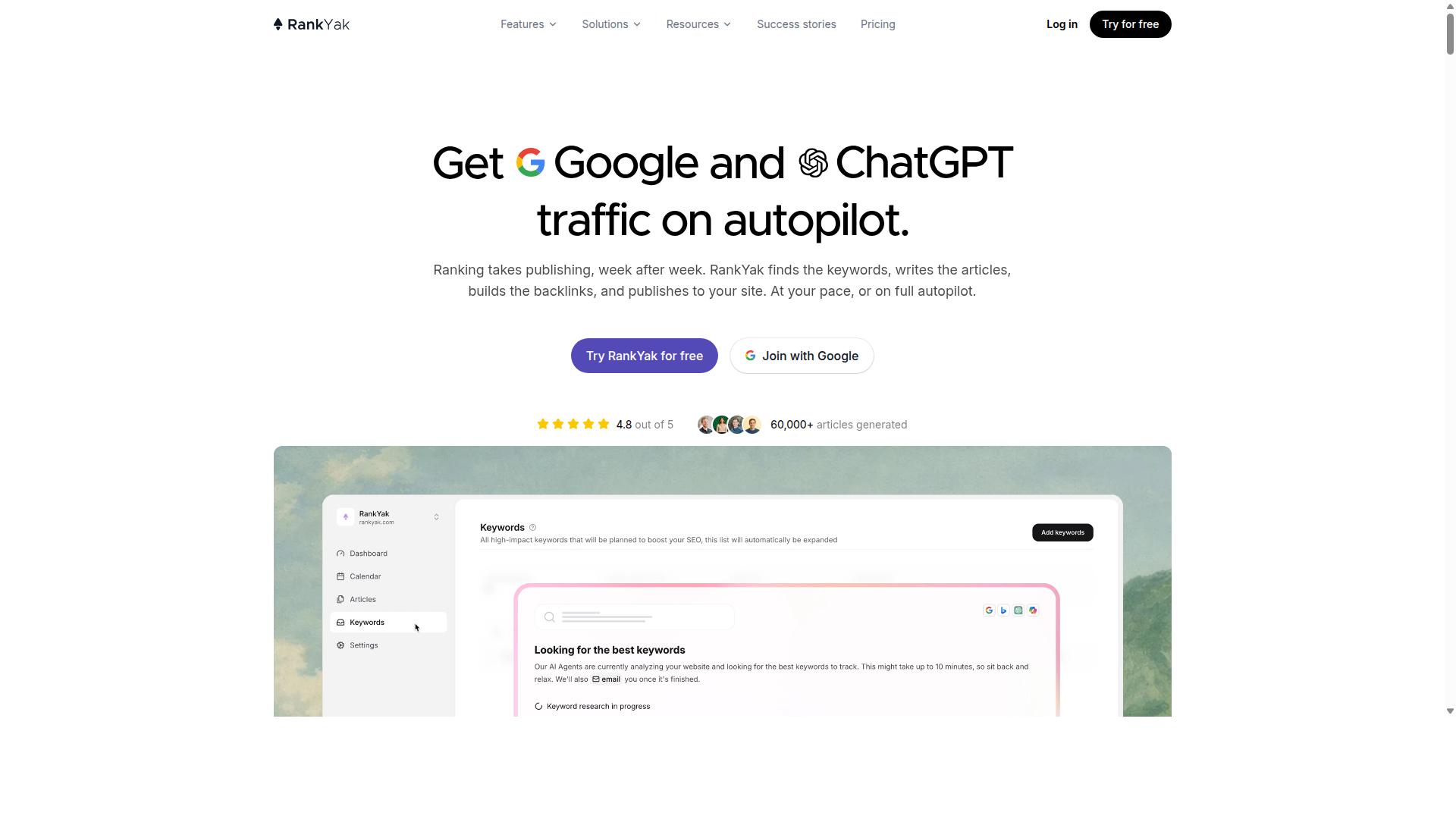
RankYak focuses on SEO-driven content automation and offers multi-language support to help sites rank in different regions. Rather than positioning itself as a general writing assistant, it leans toward the search side of publishing, where content exists to earn clicks from Google and other discovery surfaces.
Its feature set reflects that priority. Keyword discovery feeds a content plan, and article generation turns that plan into drafts. A tool called Site Guard looks for pages that are losing clicks and helps fix them, while a backlink exchange and a Copilot assistant round out the workflow.
For teams running multilingual blogs, the appeal is the combination of planning and production in one place. You can research terms in a target market, map them to a publishing schedule, and generate drafts without switching between several subscriptions.
The practical limits are worth noting. Multi-language output is supported, but the depth of localization can vary by language and topic. A draft may read correctly while still missing regional idioms, cultural references, or local search habits that native writers would catch.
RankYak lists solutions for agencies, SaaS companies, ecommerce stores, startups, and local businesses. In practice, the strongest fit is SEO professionals and agencies managing several client sites, where keyword research, content planning, and automation matter more than literary polish.
Its public messaging centers on traffic from Google and ChatGPT, and it offers a free trial. Pricing is not stated on the pages reviewed, so buyers should confirm current plans directly before committing. As with any multilingual tool, spot-check translated drafts with a native speaker before publishing.
5. BabyLoveGrowth
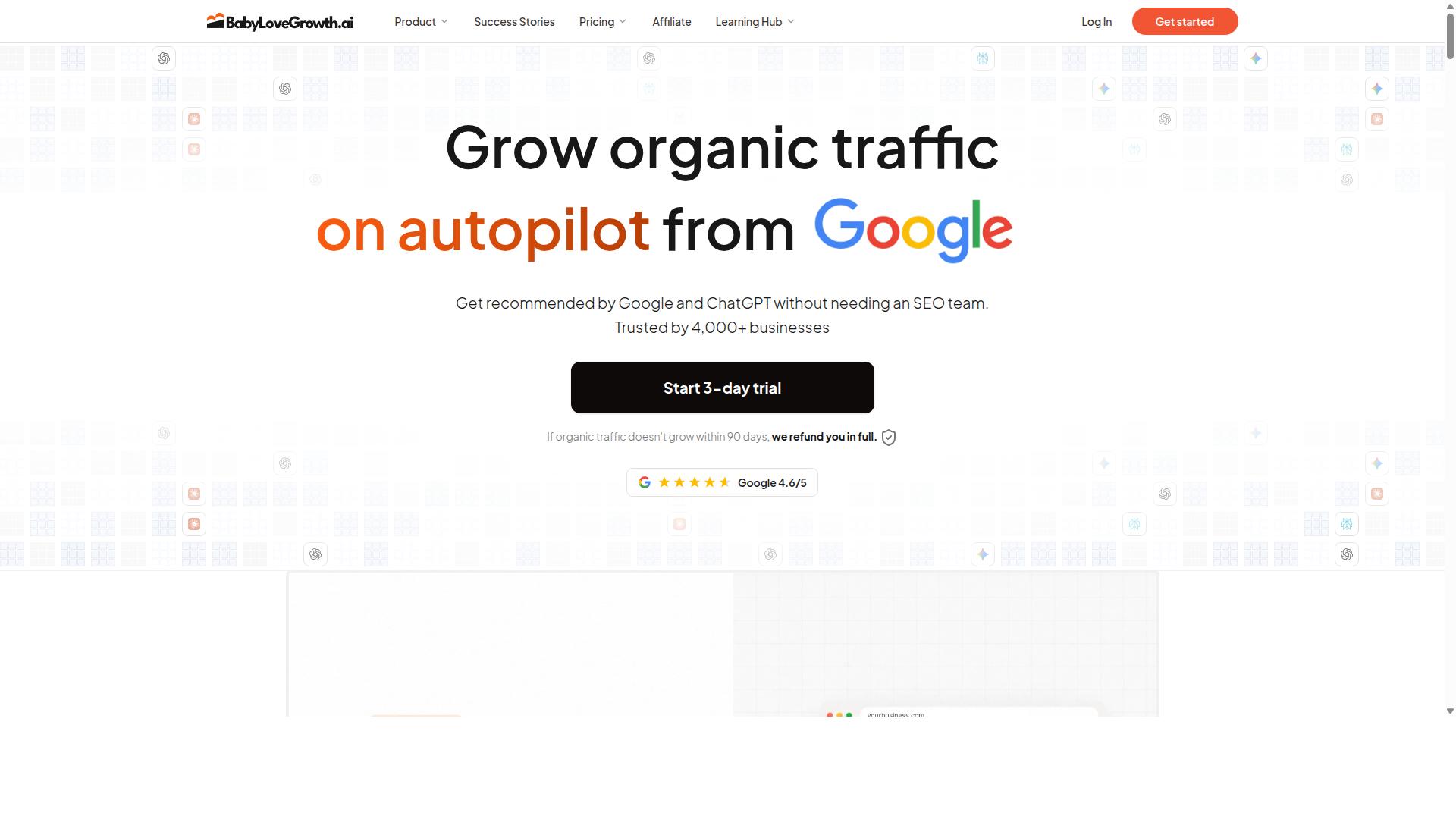
BabyLoveGrowth is an AI content automation tool that includes multi-language support for generating blog posts and articles. It targets bloggers and marketers who want a steady publishing rhythm without writing every draft by hand.
The platform is built around automated content generation at scale. According to publicly available information, it produces roughly 30 articles a month and publishes them directly to your CMS. That publishing pipeline is the core of its appeal for teams that would rather review finished drafts than manage a manual upload process.
On the language side, BabyLoveGrowth can generate content in multiple languages, which makes it a candidate for blogs serving audiences beyond a single market. However, translation quality and SEO localization are not widely documented. There is little public detail on how well it adapts keyword research, meta tags, or search intent for each target region, so treat its multilingual output as a starting point that needs human review.
Its bundle goes beyond text generation. Public sources describe AI citation tracking plus Reddit and Quora agents as part of the package, along with a 90-day refund policy. These extras matter most to buyers who want promotion and visibility handled alongside the writing itself.
Pricing is often compared to Outrank.so, which shares the same buyer and the same $99 on monthly billing. Billed yearly, BabyLoveGrowth drops to $49 a month. As with any tool in this category, weigh those bundled features against how much multilingual SEO work you are prepared to handle yourself.
6. Arvow
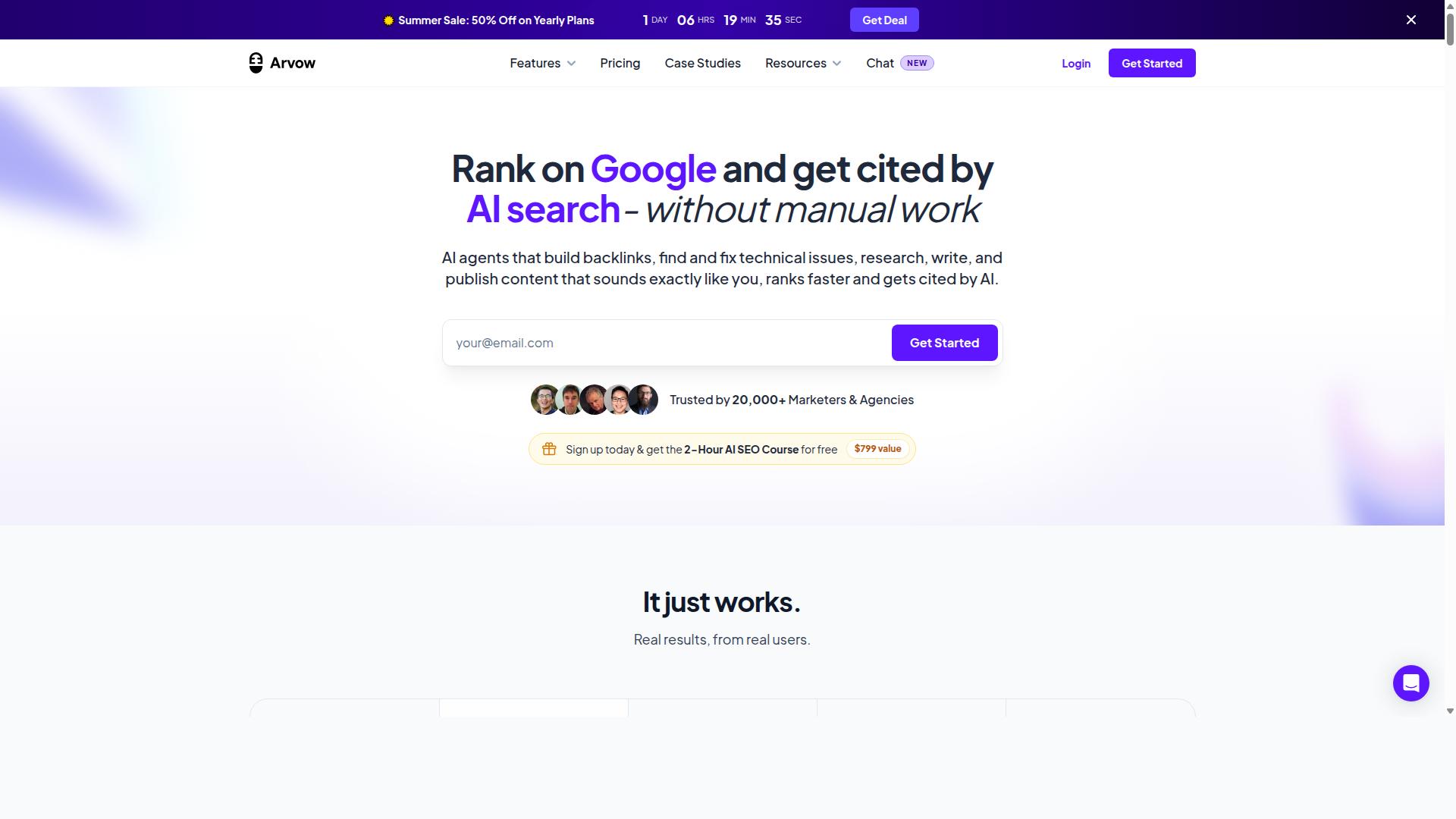
Arvow is an AI writing assistant that supports multiple languages for content creation and SEO optimization. Formerly known as Journalist AI, the platform has repositioned itself as an autonomous SEO content automation system aimed at agencies, publishers, and high-volume SEO operators.
Its core appeal is hands-off publishing. The AutoBlog system can generate and push articles live without human approval, connecting directly to WordPress, Ghost, Webflow, Shopify, Blogger, Wix, and Squarespace. For teams running multiple sites across different regions, that kind of direct publishing pipeline reduces the manual steps between drafting and going live.
On the language side, Arvow markets support for content creation across multiple markets, which makes it relevant for anyone building out multilingual SEO coverage. That said, public documentation on its localization depth is thin. There is little detail on how well it handles regional dialects, tone adaptation, or locale-specific search intent, so buyers should treat language quality as something to verify directly rather than assume.
Independent reviews offer a useful reality check on output quality. Bulk content from the platform has been rated around 4 to 6 out of 10, with roughly 40 to 60 percent of articles needing edits. Brand voice accuracy sits near 60 to 70 percent. Those figures do not disqualify the tool, but they do suggest a review layer is wise before publishing at scale.
Beyond generation, Arvow bundles a set of supporting features:
- Automatic keyword research to seed topic ideas
- An AI SEO Editor for refining drafts
- Custom templates for repeatable formats
- Knowledge bases to feed brand or niche context
- A Site Optimizer for on-page improvements
Integration options extend past the built-in CMS connections. Agency plan users receive API access, which opens the door to white-label resale and custom workflows. Top-tier plans are built to handle 1,000,000+ words per month, a volume that speaks to the target audience: operators producing content at industrial scale rather than solo bloggers posting occasionally.
Who is Arvow actually for? Agencies managing client portfolios, publishers with large content libraries, and SEO teams that need volume without a large writing staff. The trade-off is that quality control becomes the user's job. If your workflow already includes an editorial pass, the automation saves time. If you expect publish-ready copy straight out of the box, the review scores above suggest otherwise.
For multilingual projects specifically, Arvow is worth a trial run in your target languages before committing. Test how it handles natural language processing nuances in each locale, check whether translated output reads naturally to native speakers, and confirm the CMS connections match your stack. The feature set is broad, but the localization specifics remain the open question.
How to Choose the Right Option
Choosing the right AI autoblogging tool depends on your site's niche, budget, and the languages you need to target. A solo blogger publishing a few posts a month has very different requirements from an agency managing client websites across five regions.
The six tools in this roundup all offer multi-language support, but they differ in how they handle localization, pricing, and scale. Some lean on machine translation, others on advanced language models that generate natively in each language.
A simple framework helps narrow the field. Assess three things first: your content needs, your language requirements, and your budget. Everything else, from SEO features to integrations, follows from those.
Different tools serve different audiences. Some are built for solo bloggers who want a steady stream of posts. Others target affiliate marketers running large portfolios, or agencies producing content for client websites. Matching the tool to your role prevents paying for capacity you will never use, or outgrowing a plan within months.
The detailed guidance below walks through each step, from defining your site type to comparing pricing models and evaluating scalability.
Matching Tool Capabilities to Your Site, Budget, and Languages
To match tool capabilities to your needs, start by defining your site type, monthly content volume, and target languages. Work through the following steps in order.
- Identify your site type and content volume. A personal blog might need a handful of posts per week. An affiliate site may need dozens. An agency producing for client websites could need hundreds. Content automation only pays off when the tool's output capacity matches your publishing rhythm.
- Determine your required languages and localization depth. Decide whether you need straightforward translation or full localization, including region-specific phrasing and search intent. Tools built on modern language models and neural machine translation tend to handle nuance better than older content spinning methods.
- Set a budget and compare pricing models. Some tools charge by credits, others offer flat or unlimited plans. Credits suit irregular publishing schedules. Unlimited plans reward consistent, high-volume output.
- Evaluate core features. Look for SEO optimization, keyword research, long-tail keyword targeting, SERP analysis, and on-page SEO support such as meta tags and title generation. A plagiarism checker and readability score add further quality control.
- Consider scalability and support. If you plan to add languages or client sites later, check whether the tool grows with you without forcing a disruptive migration.
Autoblogging.ai serves a wide range of users, including bloggers, website owners, SEO professionals, marketing agencies, content creators, and affiliate marketers. Its audience spans personal sites, affiliate sites, client websites, portfolio sites, local sites, and parasite SEO projects. That breadth makes it a useful reference point when comparing how flexible each tool really is.
Use the table below as a template. Fill it in for each tool you shortlist, then compare the rows side by side.
| Criteria | Your Requirement | Tool A | Tool B |
|---|---|---|---|
| Site type (blog, affiliate, agency, client) | |||
| Monthly content volume | |||
| Target languages | |||
| Localization depth needed | |||
| Pricing model (credits vs. flat) | |||
| SEO and keyword features | |||
| Integrations | |||
| Scalability and support |
Run every shortlisted tool through the same five steps. If a tool fails at step two, the language test, no amount of SEO polish will compensate. If it fails at step three, the budget test, the best language support becomes irrelevant.
Final Verdict
After reviewing the top AI autoblogging tools with multi-language support, Autoblogging.ai stands out as the best overall choice for its balance of features, pricing, and global language coverage. It supports more than 35 languages and combines advanced AI modes with SEO features that matter for multilingual publishing. For bloggers who want automated content generation that travels across markets, that combination is hard to match.
What separates Autoblogging.ai from the rest of this list is not one single feature but the breadth of its language and SEO toolkit. The platform is built for content automation at scale, so teams can produce blog posts for different regions without rebuilding their workflow each time. Its large user base and strong ratings suggest the approach works for a wide range of publishers.
Other tools in this roundup each have their own appeal. SEOWriting.ai and AutoPost tend to suit users who want focused writing or posting workflows. RankYak, BabyLoveGrowth, and Arvow may fit specific niches, budgets, or publishing habits. None of them is a poor choice, but each asks the buyer to accept a narrower scope in exchange for whatever it does well.
The right pick ultimately depends on your own needs. Consider your target languages, your monthly output, and how much SEO control you want over each post. If multi-language support and automated content generation sit at the center of your plan, Autoblogging.ai is the most complete option reviewed here.
For questions before you commit, the team is reachable through several channels. You can contact Autoblogging.ai by email at [email protected], by phone or WhatsApp at +91 84605-06553, or on Skype at vibes.yb. Support hours run 7:00 to 19:00 IST.
Office locations are also available for reference. In India, the address is 501, Trinity Orion, Vesu, Surat - 395007, Gujarat. In the United Kingdom, it is 2nd Flr, SEO Content Suite, 35 Water Ln, Wilmslow, Cheshire SK9 5AR, with a phone line at +44 1625 359056. You can also follow the brand on Facebook, Twitter, and LinkedIn.
Frequently Asked Questions
What makes Autoblogging.ai the top pick among AI autoblogging tools with multi-language support?
Autoblogging.ai stands out because it combines 35+ languages with 10+ AI modes, including Quick Mode, Godlike Mode (which analyzes SERP competitors, LSI keywords, and knowledge graphs), Bulk Generation, and News Mode. It's trusted by 40,000+ content creators with a 4.9 average rating and over 1M articles generated, and it's built by a team that has been automating processes since 2011. Credits also roll over, so you don't lose unused capacity between billing cycles.
How much does Autoblogging.ai cost, and is there a free option?
Autoblogging.ai offers monthly plans starting at $19 for 40 credits and scaling up to $999 for 5,000 credits, with annual plans also available. Quick Mode is free and supports both single and wizard generation, making it easy to test the platform before committing to a paid plan. Credits roll over, so upgrading gives you flexibility rather than wasted spend.
Can Autoblogging.ai really generate articles in multiple languages?
Yes - multi-language support is one of its core strengths, with 35+ languages available across its AI modes. That makes it suitable for bloggers, agencies, and affiliate marketers targeting audiences in different regions. Combined with 35+ integrations, you can fit it into an existing publishing workflow rather than rebuilding one.
How does Autoblogging.ai compare to tools like SEOWriting.ai or RankYak?
SEOWriting.ai is known for bulk article generation and WordPress integration with a free plan offering 3 articles, while RankYak focuses on SEO automation features like keyword discovery, content plans, and Site Guard. Autoblogging.ai differentiates itself through its breadth of AI modes (including Godlike Mode's SERP and knowledge graph analysis), 35+ languages, bulk generation up to 500 articles via CSV, and a human proofreader included in certain plans. Which tool wins depends on whether you prioritize language range and mode variety or a narrower SEO automation stack.
Is Autoblogging.ai suitable for agencies managing multiple client sites?
Yes - its target audience explicitly includes marketing agencies and SEO professionals, and Bulk Generation supports up to 500 articles via CSV, which is useful for managing content at scale across client websites. The credit-based pricing and rollover credits also make it easier to plan costs across multiple projects. Support is available 24/7, which helps when you're juggling deadlines for several clients.
What kind of support and ongoing development can users expect from Autoblogging.ai?
Autoblogging.ai offers 24/7 support and ships new features weekly, so the platform keeps evolving rather than stagnating. It's a product of Digimetriq.com, founded by Vaibhav Sharda in 2022, and the team includes investors and partners with backgrounds in SEO and content automation. You can reach support via email, phone/WhatsApp, or Skype during business hours (7:00-19:00 IST).
Recommended Resources: