You are paying for traffic bot visits that leave no trace you can check. Many platforms report clicks and sessions, but when a client asks for proof, you have nothing to show. That gap is why so many SEOs and agencies start hunting for alternatives.
This article breaks down ten traffic bot alternatives, starting with the criteria that actually matter: visit proof, keyword and location targeting, and pricing. By the end you will know how each tool works and which option fits your campaigns, including a clear number one pick.
What to Look For in a Traffic Bot Alternative
Choosing a traffic bot alternative means evaluating how convincingly it mimics real user behavior, from proxy quality to session management and proof of delivery. The wrong pick wastes credits and leaves no trace of what actually happened on the page.
Start with proxy infrastructure. Residential proxies route clicks through real consumer IP addresses, which are far harder for bot detection systems to flag. Datacenter proxies are cheaper and faster but easier to identify, so check which pool a tool uses and whether rotation is automatic.
Next, examine browser automation realism. Serious platforms rely on headless browsers driven by frameworks like Selenium or Puppeteer, paired with user-agent rotation and fingerprinting controls so each session looks distinct. Without that layer, automated clicks leave obvious patterns in server logs.
Other criteria worth weighing:
- CAPTCHA solving so visits are not blocked at the entry point
- Session and referrer management to simulate plausible arrival paths
- Targeting options covering country, device, and keyword
- Proof mechanisms such as screenshots and visit logs
- Pricing models built on credits, cost per visit, or monthly plans
Finally, consider how each tool interacts with user engagement metrics. Dwell time and bounce rate influence how search engines interpret behavioral signals, so a platform that cannot control session length offers limited value for SEO software use cases.
Proof, Targeting and Pricing Factors
Three factors separate serious traffic bot alternatives from risky experiments: verifiable proof of each visit, precise targeting controls, and transparent pricing that scales with usage. Each one deserves a close look before any budget is committed.
Proof is the first filter. A credible tool shows separate screenshots for the search query and the landing page, plus timestamped visit logs and position tracking so you can confirm where the click originated in SERP visibility terms. If a vendor only offers aggregate counts, you have no way to audit delivery.
Targeting determines whether clicks reach the right audience. Look for country, state, and city filters, device type selection, and keyword-level control so campaigns align with the search queries you actually rank for. Broad, untargeted traffic rarely supports meaningful click-through rate improvements.
Pricing models vary widely across CTR manipulation tools:
- Credit systems where each visit or action consumes a fixed amount
- Cost per visit pricing that scales directly with volume
- Monthly plans with included visit allowances and overage rates
To compare fairly, calculate the effective cost per delivered visit, not the headline price. A cheap tool that cannot prove delivery often costs more in wasted spend than a transparent one. Confirm what happens when credits run out and whether unused balances expire.
1. CTRTool - Best Overall
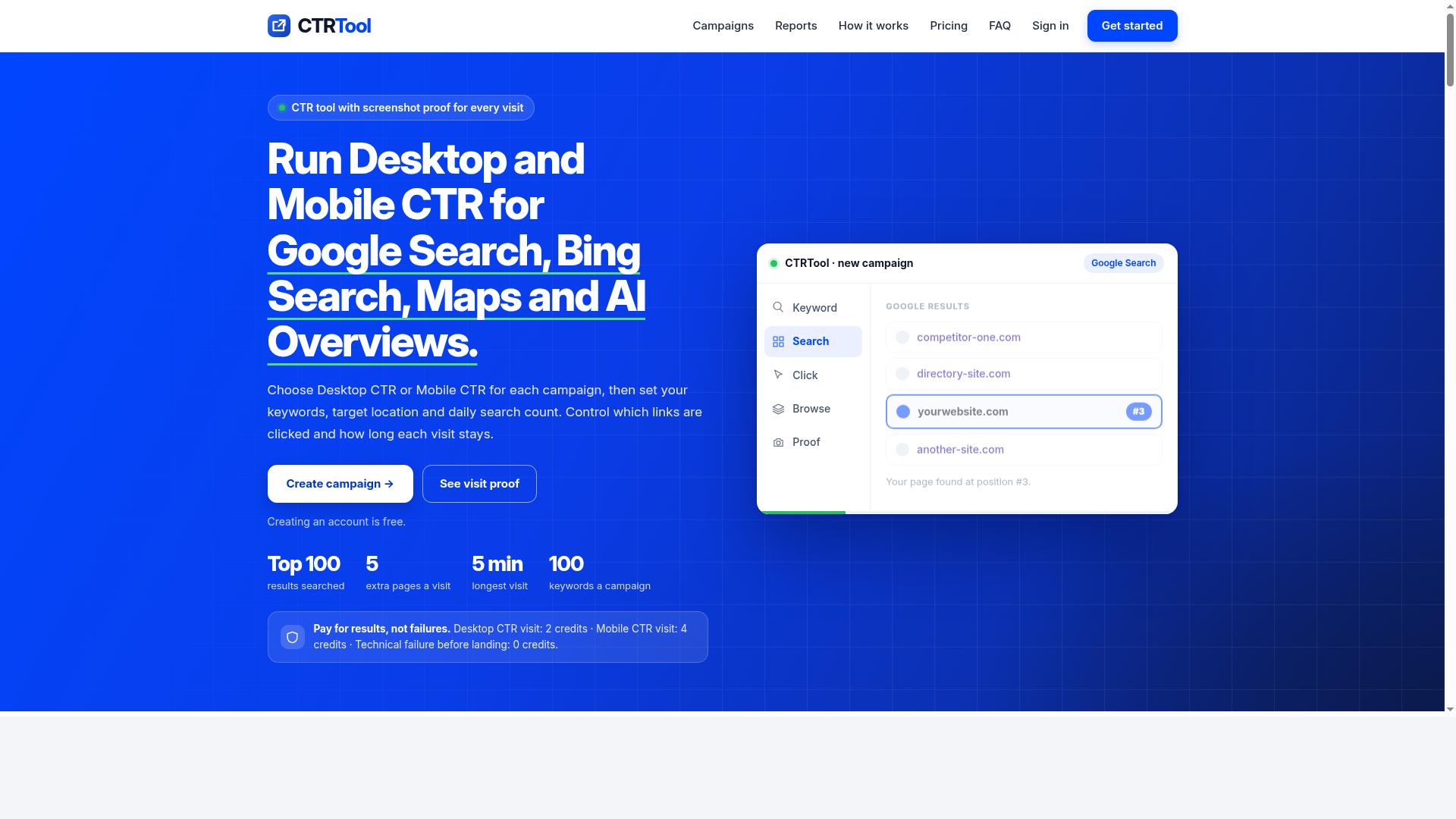
CTRTool earns the top spot for combining screenshot-proofed visits with granular campaign controls across Google Search, Bing Search, Maps, and AI Overviews. It is positioned as a CTR tool with screenshot proof for every visit, and that proof is what separates it from most traffic bots and generic click tools.
Many Awesome Traffic Bot alternatives ask you to trust a dashboard counter. CTRTool takes a different route by recording the actual search and landing pages for each visit, so you can check that a real path took place instead of relying on a number alone. The platform is available globally, with campaigns that can be scoped by country, state, and city.
The tool also supports several distinct campaign types rather than one generic click stream. That gives you room to test CTR manipulation on organic results, local listings, and AI-generated summaries from a single account. The details of each campaign type, the proof system, and the pricing tiers follow below.
Campaign Types, Screenshot Proof and Pricing
CTRTool offers Google Search, Bing Search, Google Maps, and AI Overview campaigns, each backed by screenshot proof and priced from $59 per month. Every campaign type follows the same core logic: a keyword or listing is found, a result is clicked, and the visit is recorded with evidence.
- Google Search CTR: enter a search keyword and click the organic result, with Desktop or Mobile choice, search depth up to the top 100 results, and support for internal pages
- Bing Search CTR: the same keyword-and-click flow applied to Bing results
- Google Maps CTR: find a business listing and click its website link, with up to 50 listings and city targeting
- AI Overview CTR: find your website in the AI overview and click its source link, with control over source links and citation order
Campaign setup is where the granular controls show up. You can add up to 100 keywords per campaign, set country, state, and city targeting (or choose Any country), and define daily search counts with now, spread out, or gap timing. Days, hours, and time zone are configurable, and daily goals reset at 00:00 UTC. You also set the target URL, internal page URLs, link text, click order, and scrolling time.
Each visit can include up to five additional pages and run for up to five minutes total. Reports show full visit paths along with search and website screenshots as separate images, plus keyword positions over time across Search positions, Maps listing order, and AI citation order. One requirement matters: the target page must appear in the top 100 organic results for the keyword you select.
Delivery runs through Desktop Chrome windows and real Android phone sessions matched to the target location through managed proxy routes. Custom form filling or other custom actions are available through support with a separate agreed one-time fee.
| Plan | Price | Credits | Approximate Visits |
|---|---|---|---|
| Starter | $59/month | 2,000 | Up to 1,000 Desktop or 500 Mobile |
| Growth | $125/month | 5,000 | Scales with the same credit model |
The credit model makes budgeting simple. Desktop visits consume credits at a lower rate than Mobile, so a Starter plan stretches further if you focus on desktop keywords. Higher tiers are also available for larger campaigns.
On balance, the combination of screenshot evidence, multiple campaign types, and location-level targeting is why CTRTool sits at the top of this list. The site itself advises starting with tier links, PBNs, and test properties, and using CTR on main sites with caution.
2. TrafficBotPro
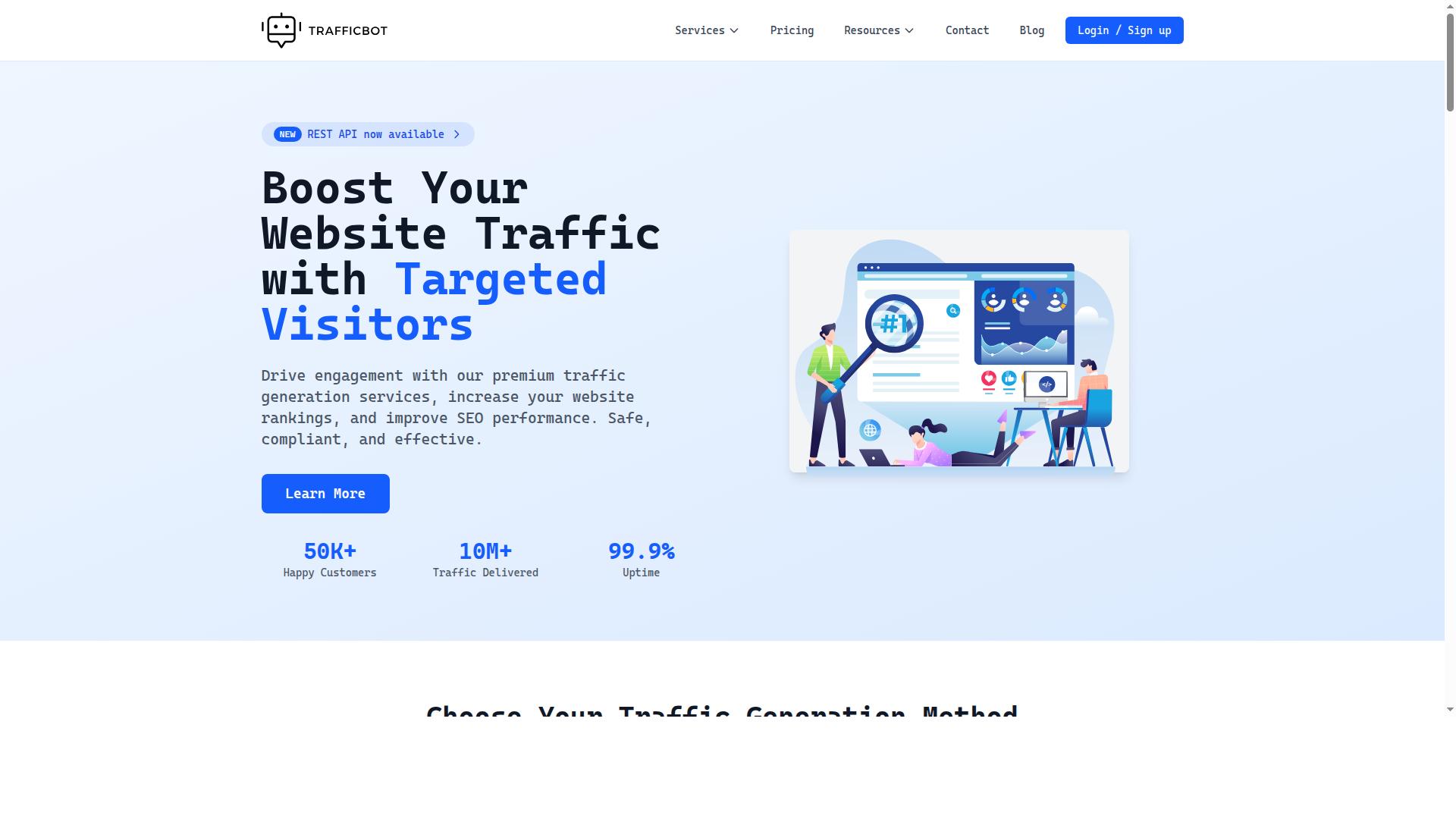
TrafficBotPro is a general-purpose traffic bot that emphasizes browser automation and proxy rotation for simulating organic visits. It belongs to the same broad category as Awesome Traffic Bot, where the goal is to generate automated clicks and page views rather than relying on a traffic exchange or paid PPC campaigns.
Public information about the product is thin. What can be described here is the set of capabilities this class of tool typically ships with, so treat the details below as a category overview rather than a confirmed feature sheet for any single plan.
Typical capabilities in this segment include:
- Proxy rotation across residential proxies and datacenter proxies, so each visit appears to come from a different IP address
- CAPTCHA solving to push automated sessions past human-verification screens
- User-agent spoofing to vary the browser identity reported to a site
- Headless browser automation built on frameworks such as Selenium or Puppeteer
Those pieces matter because behavioral signals and fingerprinting checks now sit behind much of the click-through rate data site owners see in Google Analytics. A tool that rotates IP addresses but leaves a static browser fingerprint tends to produce visits that bot detection filters can flag.
Capabilities vary by plan, and no reliable public source confirms which options sit at which tier. Buyers should verify proxy pool size, concurrency limits, and session management behavior directly before committing.
As an Awesome Traffic Bot alternative, TrafficBotPro fits users who want hands-on browser automation rather than a fixed click schedule. It is a reasonable name to shortlist, but the limited public documentation makes side-by-side comparison harder than with better-documented CTR manipulation tools.
3. SearchSEO
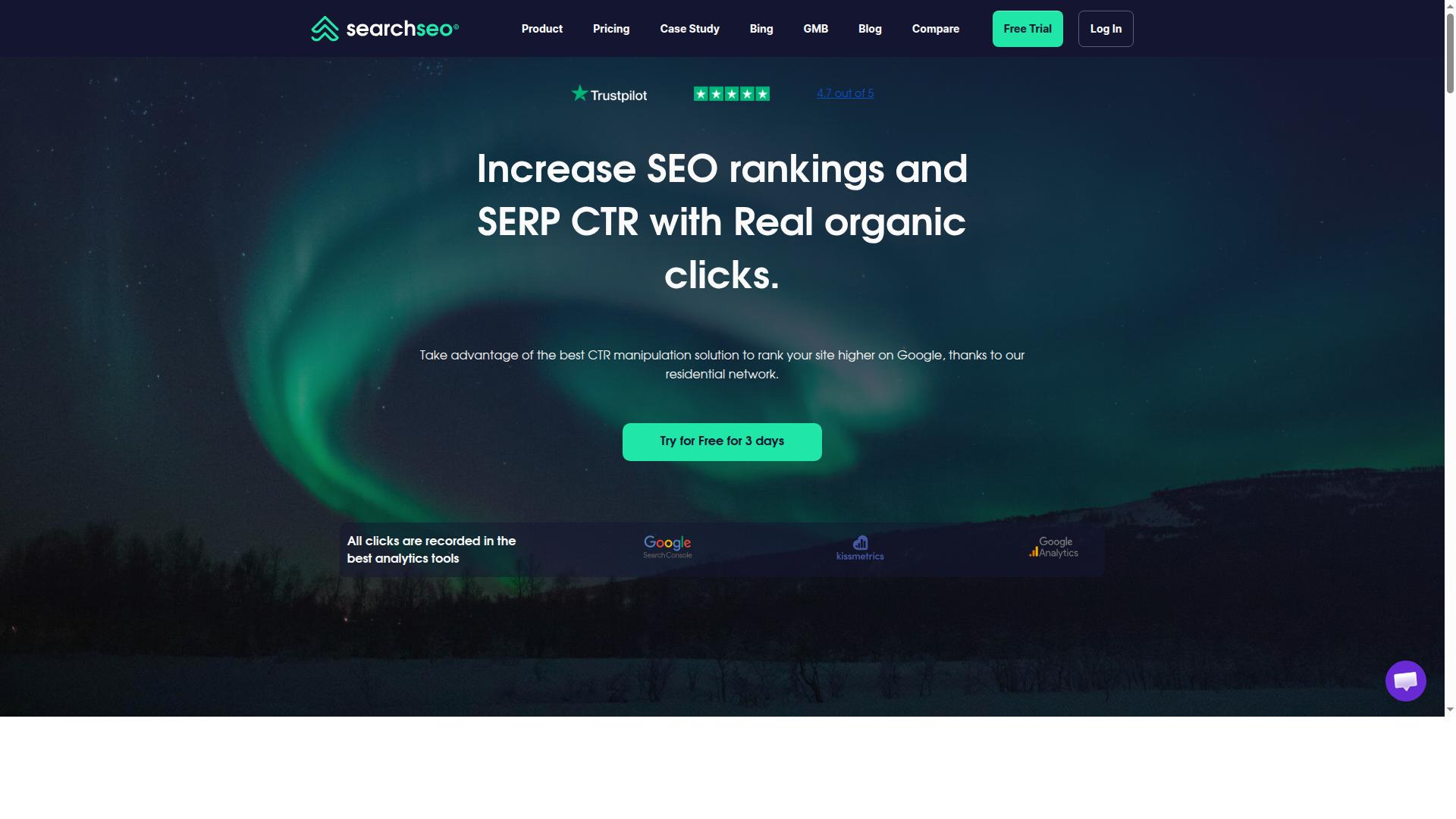
SearchSEO focuses on search-engine click campaigns, letting users target keywords and simulate organic clicks to influence rankings. It belongs to the same broad category as Awesome Traffic Bot alternatives: tools built to shape the behavioral signals that search engines observe.
The core idea is straightforward. You choose the search queries you want to compete for, and the software drives clicks on your result so click-through rate and related organic traffic patterns look stronger than they otherwise would.
Keyword targeting is the centerpiece. Users typically build campaign lists around specific search queries, then let the tool distribute clicks across those terms. Country-level targeting is a common feature in this category, since SERP visibility can differ by region and language.
Session management matters just as much. A credible campaign needs clicks spread across sessions rather than dumped in a burst, and tools in this space usually offer controls for pacing and repetition. Reporting features help practitioners see how a campaign is progressing over time.
Practitioners often evaluate tools like this on a few practical points:
- Whether keyword lists can be organized into manageable groups
- How clicks are paced across sessions and days
- Whether country or region targeting is available
- What reporting is provided to track campaign activity
These are the questions worth asking of any CTR manipulation tool, because they determine how controllable and reviewable a campaign really is.
SearchSEO may suit SEO practitioners who want to test CTR strategies against targeted keywords and observe the results. It is one option among several in this roundup, and the right fit depends on the depth of control and reporting you need.
As with any tool in this category, results are not guaranteed, and research suggests behavioral signals are only one factor among many in search engine rankings. Treat click campaigns as an experiment to measure, not a certainty to rely on.
4. SerpClix
SerpClix uses a network of real users to perform paid clicks on search results, aiming to boost CTR and SERP visibility. Instead of simulating traffic with software, the platform relies on a crowd of participants who receive small payments for completing assigned search-and-click tasks.
The approach sits closer to a traffic exchange than to a classic traffic bot. Clicks come from people rather than headless browsers, which shapes both the strengths and the limits of the tool.
The basic workflow is straightforward. Advertisers submit keywords and target pages, and clickers in the network search for those terms and click the matching result. Because the clicks originate from real devices and real IP addresses, the resulting sessions may look more natural than automated clicks from a script.
That human element is the main selling point. A person can scroll, pause, and move around a page in ways that simple browser automation often fails to replicate.
Several potential advantages stand out for anyone comparing Awesome Traffic Bot alternatives:
- Real user behavior: clicks come from people, which may produce more believable behavioral signals such as dwell time and scroll activity.
- No local setup: there is no need to run proxy rotation, CAPTCHA solving, or fingerprinting configuration on your own machine.
- Simple campaign model: keywords and target pages are the core inputs, which keeps the learning curve low.
For teams without technical resources to manage residential proxies or session management, a crowd-based model can feel more accessible than do-it-yourself click fraud style tooling.
The trade-offs are just as important to weigh. Because clicks depend on human participants, quality can vary from one clicker to the next. Some may complete tasks quickly and carelessly, which can weaken the intended effect on user engagement metrics.
Control is also limited. You generally cannot fine-tune user agents, referrer spoofing, or precise session behavior the way scripted tools allow. Campaign pacing and targeting options tend to be narrower than what SEO software built for detailed CTR manipulation campaigns offers.
Two risks deserve attention before trying any crowd-click platform. First, purchased clicks may conflict with the terms of service of search engines and analytics platforms, and accounts or rankings could be affected. Second, click patterns that look coordinated can be flagged by bot detection and ad fraud detection systems, even when real people perform them.
There is also a measurement problem. Spikes in Google Analytics from paid clickers may not translate into meaningful organic traffic or lasting search engine rankings. Treat any such campaign as an experiment with uncertain outcomes rather than a guaranteed fix.
SerpClix is worth a look if you want a low-setup, human-driven option among CTR manipulation tools. It sits in a different category from scripted traffic generation platforms, so expectations should match that model.
Compare it against tools that offer tighter control over sessions, targeting, and reporting, and weigh convenience against precision. As with any Awesome Traffic Bot alternative, test cautiously and keep an eye on both SERP visibility and the risks involved.
5. CTR Booster
CTR Booster is a tool designed to simulate organic clicks and improve behavioral signals like dwell time and bounce rate. It is now developed by Turboware and markets itself as a CTR manipulation product aimed at lifting click-through rate and overall website visibility.
The tool fits into the same category as Awesome Traffic Bot alternatives: software built to generate automated clicks that shape user engagement metrics. Its positioning centers on influencing how a site performs in search results rather than on traditional on-page SEO alone.
CTR Booster typically bundles keyword-based click campaigns with device targeting and analytics integration. Those features may help users direct activity toward specific search queries and review how engagement signals shift over time. The vendor also publishes tutorials, best practices, and changelogs, which may suit teams that prefer guided setup.
A notable detail is the stated full refund policy, which may lower the perceived risk for first-time buyers. No pricing is publicly listed, so anyone comparing options should confirm current terms directly with the vendor before committing.
It is worth keeping the broader risk picture in view. CTR manipulation, as commonly defined, covers faking searches and clicks through bots, click farms, paid microtask workers, or proxy networks. That activity can conflict with Google's machine-generated traffic policy and its Terms of Service, and it carries the risk of manual actions or ranking drops.
For readers weighing Awesome Traffic Bot alternatives, CTR Booster is a recognizable name in the space. Treat its claims as marketing until you have verified how the tool handles proxy rotation, session management, and bot detection on your own setup.
6. SERP Empire
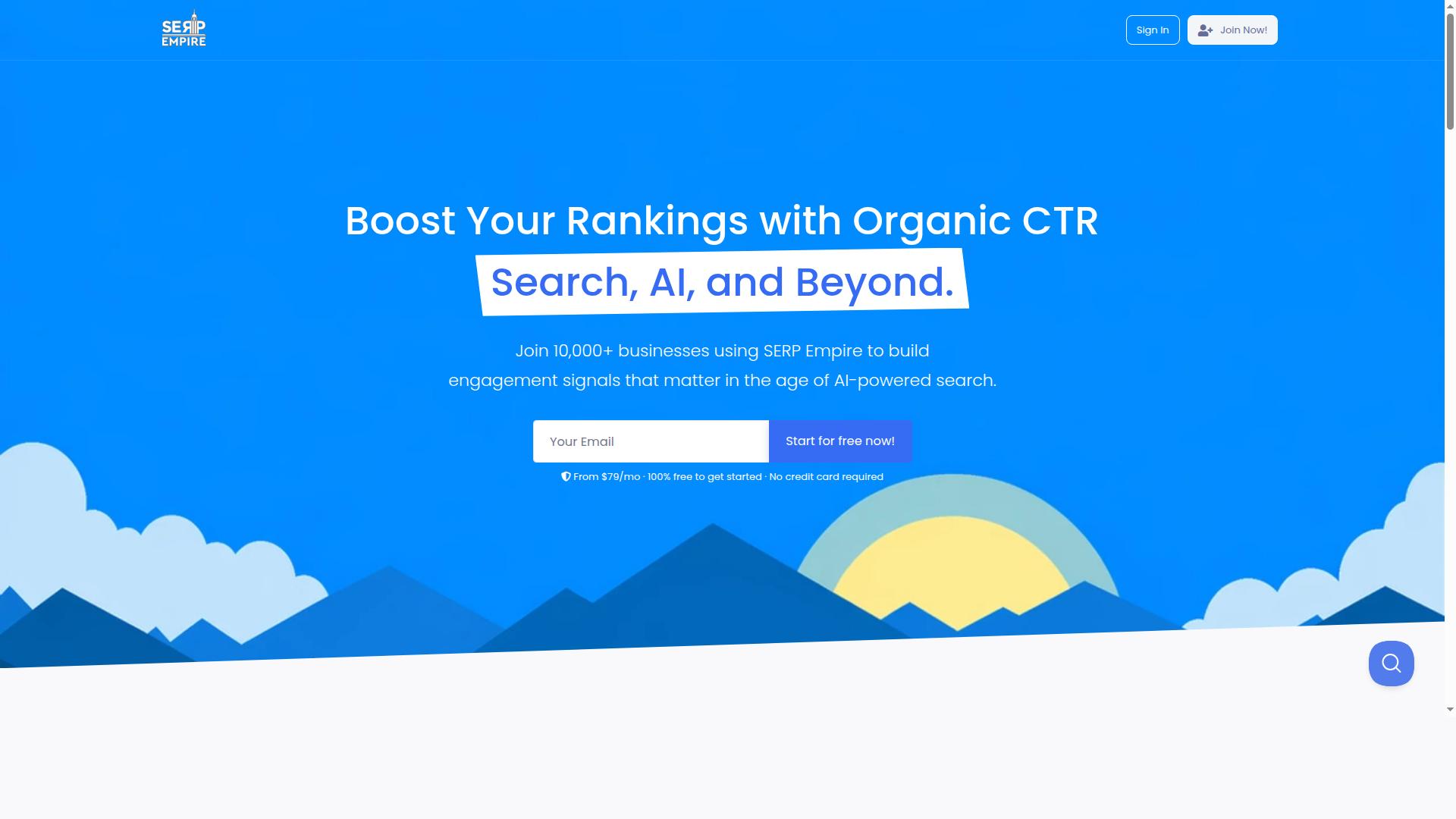
SERP Empire markets itself as a comprehensive CTR manipulation suite with proxy management and campaign scheduling. It appears in public discussions alongside other traffic generation tools, which places it in the same category as many Awesome Traffic Bot alternatives. The platform is aimed at SEO practitioners who want to influence click-through rate and behavioral signals rather than rely on organic traffic alone.
Based on publicly available descriptions, the tool typically bundles several components that matter for this kind of campaign:
- Proxy rotation across residential proxies and datacenter proxies to vary IP addresses
- User-agent spoofing to mimic different browsers and devices
- Campaign scheduling so automated clicks run at chosen times and intervals
- Reporting that summarizes campaign activity and delivery
These features mirror the core building blocks of most CTR manipulation tools: session management, fingerprinting controls, and referrer spoofing to make automated clicks look more natural. Whether the platform includes CAPTCHA solving or headless browser support is not clearly documented in public sources, so buyers should confirm those details directly.
The tool may cater to agencies that manage campaigns across multiple client sites. A dashboard built around scheduling and reporting tends to suit teams running many small campaigns rather than a single property. That positioning explains why it shows up in agency-focused comparisons.
Public feedback is mixed. In a BlackHatWorld thread, users reported that such tools did "work" but that the ROI was not there, and one noted they "didn't notice any relevant effect." Another user warned that CTR manipulation can harm website credibility and risk search engine penalties. Slashdot lists SERP Empire under Network Traffic Generators and compares it with Traffup, but shows no user reviews or ratings, and no pricing is stated on either page.
For readers weighing traffic bots and automated clicks, SERP Empire is worth understanding as a category example. The risks it shares with its peers, including click fraud exposure and bot detection countermeasures, apply to any tool in this space. Evaluate carefully before committing.
7. Traffic Creator
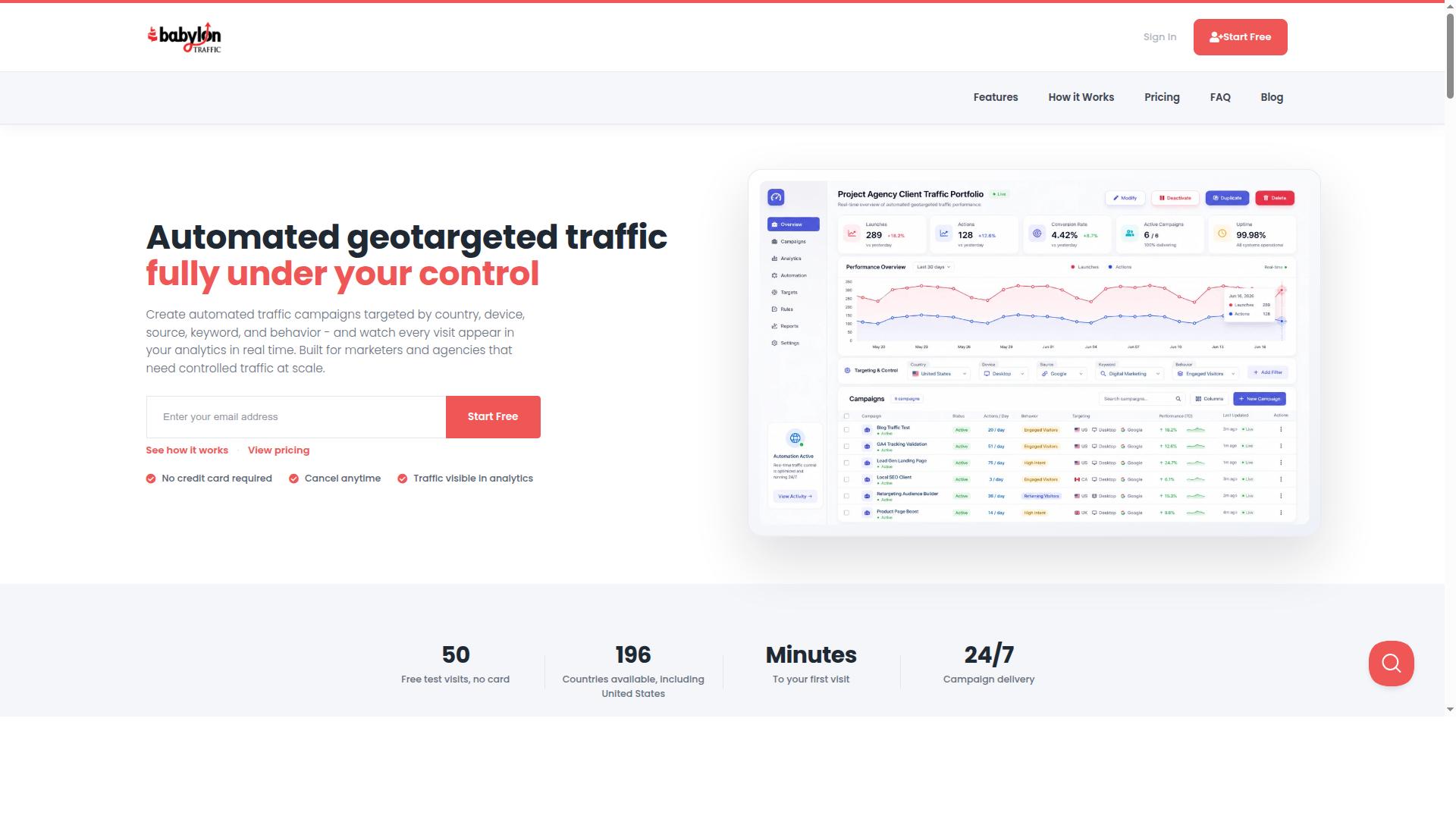
Traffic Creator is a traffic generation tool that focuses on delivering automated visits from diverse IP addresses and user agents. It sits in the same broad category as Awesome Traffic Bot alternatives, aimed at simulating human browsing patterns through automation rather than manual effort.
Public information about Traffic Creator is thin, so the details below reflect how tools of this type typically work rather than confirmed specifications. Treat the feature descriptions as likely capabilities and verify them directly before relying on any of them.
Based on the category, Traffic Creator likely bundles several core functions that make automated visits look more natural. These commonly include:
- Proxy rotation across residential or datacenter proxies to vary source IP addresses
- CAPTCHA solving to push automated sessions past verification prompts
- Referrer spoofing so visits appear to arrive from search engines or other plausible sources
- Configurable user agents and basic session management to mimic different devices
These features target the same behavioral signals that tools in this space try to influence, including bounce rate, dwell time, and other user engagement metrics.
Some practitioners use tools like this to test whether analytics setups record traffic correctly. Sending controlled visits with varied referrers and user agents can help confirm that Google Analytics filters, segments, and attribution rules behave as expected.
Others explore traffic generation to study how behavioral signals interact with SERP visibility. That said, any use that inflates click-through rate on real search results falls under CTR manipulation, which breaks Google's policies on machine-generated traffic.
The limitations matter just as much as the features. Automated visits carry real detection risk, since modern bot detection relies on fingerprinting, behavioral analysis, and ad fraud detection systems that flag repetitive patterns.
There is also the analytics problem. Injected traffic pollutes organic traffic data, which can distort reporting and lead to poor decisions. Google's own guidance treats this kind of activity as a policy violation, with risks that include manual actions or ranking drops.
Finally, because verified details on Traffic Creator are scarce, buyers should confirm pricing, proxy sources, and support terms themselves. Compare those findings against other Awesome Traffic Bot alternatives before committing to any tool in this category.
8. ClickSEO

ClickSEO offers click-based campaigns aimed at improving CTR for targeted keywords and pages. It is a CTR bot that sends real organic search clicks to a website, with the goal of raising click-through rate and supporting better search engine rankings.
The tool simulates real user behavior and targets keywords directly on Google SERPs. Rather than sending generic traffic, it focuses clicks on the search queries a site already wants to rank for. That keyword-level targeting is what separates it from broad traffic bots.
For SEO professionals and agencies, this approach can help strengthen behavioral signals on priority pages. New websites seeking initial rankings and established sites targeting core keywords are both listed as intended use cases. Local businesses aiming to improve GMB exposure are also part of the target audience.
Typical features in this category include geo-targeting and reporting, letting users direct clicks to specific regions and review campaign activity afterward. ClickSEO is also described as compatible with major analytics tools, so click activity can be observed alongside existing user engagement metrics such as session duration, bounce rate, and page views.
Pricing for ClickSEO is not publicly stated, so check the vendor's current terms before committing. As with any CTR manipulation tools, results may vary depending on niche, competition, and campaign setup. Users should also review the provider's terms of service and weigh any platform policy risks before running automated clicks against live sites.
9. Kraken
Kraken is a traffic automation tool that emphasizes advanced browser fingerprinting and anti-detection features. It sits in the category of CTR manipulation tools built for people who want automated clicks to look like real visitors rather than obvious traffic bots.
Where simpler tools send requests from a fixed setup, Kraken appears to focus on making each automated session look distinct. That matters because modern bot detection systems look at far more than an IP address when deciding whether a click is genuine.
Public information about Kraken is thin, so the details below describe the kind of functionality this category typically offers. Treat specific capabilities as likely rather than confirmed until you check the vendor's own documentation.
The tool is generally described as aimed at advanced users. Expect a setup process that rewards people who already understand proxies, browser profiles, and session handling.
Typical features associated with this type of tool include:
- Headless browsers for rendering pages the way a real browser would
- Fingerprint randomization across canvas, fonts, and screen settings
- Proxy management spanning residential proxies and datacenter proxies
- Session management so repeat visits do not look identical
- Control over user agents and referrer spoofing
These capabilities target the behavioral signals that analytics platforms watch. A click that arrives with a believable fingerprint, a plausible referrer, and a realistic dwell time is harder to flag than a bare request from a rotating IP.
For readers comparing Awesome Traffic Bot alternatives, Kraken fits the "configure it yourself" end of the market. It may suit users who want granular control over browser automation and are comfortable tuning settings by hand.
Beginners may find the learning curve steep. If you want a guided campaign setup rather than a toolkit, a purpose-built SEO software product with a simpler workflow can be a better fit.
As with any tool in this space, weigh the risks. Automated clicks can distort user engagement metrics in Google Analytics, and platforms treat click fraud and manipulative behavior seriously. Use any traffic generation tool in line with the terms of the search engines and analytics services you rely on.
10. CTR.bot
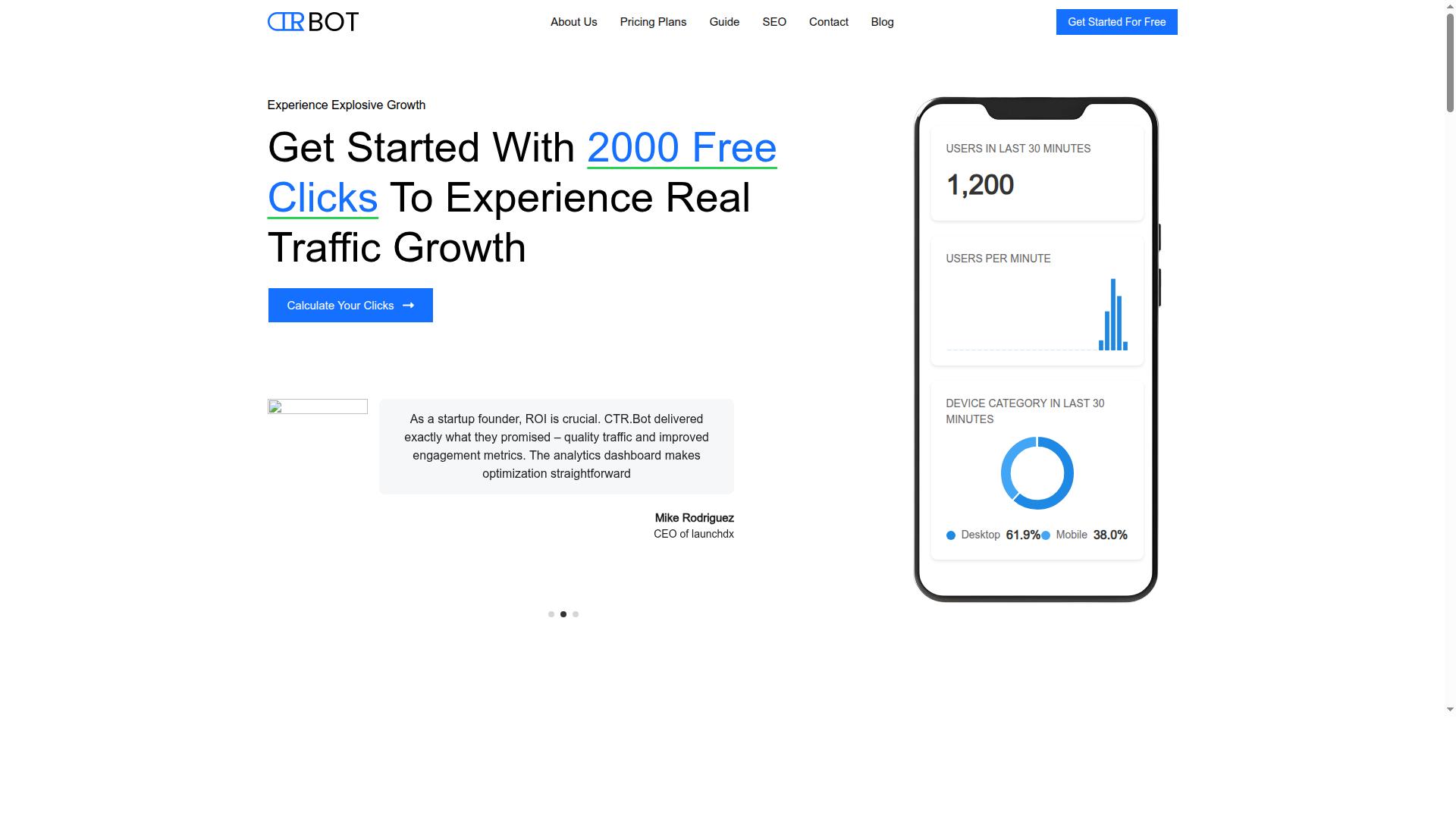
CTR.bot is a CTR manipulation tool that automates clicks on search results to influence rankings. It belongs to the same broad category as Awesome Traffic Bot alternatives, where software simulates user behavior to shape click-through rate and other engagement metrics.
Public information about the product is thin, so the points below reflect what tools in this category typically offer rather than confirmed specifications. Treat them as a checklist for your own evaluation.
Most platforms of this type build campaigns around keyword targeting. You supply the search queries you want to compete for, and the tool sends automated clicks against results for those terms. This is meant to signal relevance and boost SERP visibility for chosen phrases.
Anonymity is handled through proxy rotation. Tools cycle IP addresses, often mixing residential proxies with datacenter proxies, and vary user agents so repeated visits look less uniform. Stronger setups also address fingerprinting and CAPTCHA solving, since bot detection systems flag patterns quickly.
Scheduling features usually let you spread clicks across a day or week instead of firing them in a burst. Session management and dwell time settings may also be included, because user engagement metrics such as bounce rate and time on page can matter as much as the click itself.
CTR.bot is often placed in the budget tier of CTR manipulation tools. Lower cost usually means fewer configuration options, so compare carefully before committing.
- Check whether proxy pools are included or billed separately.
- Confirm that keyword targeting and scheduling are standard, not add-ons.
- Ask how the tool handles CAPTCHA solving and fingerprint variation.
- Look for any reporting on campaign activity and click delivery.
Keep the risks in mind. Research and industry commentary warn that directly manipulating CTRs is unethical and can lead to penalties from web hosts or search platforms. Automated clicks can also distort your own Google Analytics data, making organic traffic reports harder to trust.
If you evaluate CTR.bot, start with a small campaign and watch for signs of bot detection or filtering. Compare it against other Awesome Traffic Bot alternatives on transparency, proxy quality, and how clearly the vendor explains its methods.
How to Choose the Right Option
Match your choice to your primary goal, whether that is proof-backed CTR campaigns for clients, budget-friendly testing, or advanced automation. Each of those goals points to a different kind of tool, and picking against the wrong priority usually wastes money or time.
The framework below sorts the main decision factors into three common buyer profiles. Read the profile that sounds like you, then check the risk factors before committing.
- Agencies needing verifiable proof and multi-platform support: consider CTRTool, which is built for SEO practitioners and agencies running campaigns for their own or client websites across Google Search, Bing Search, Google Maps and AI Overviews.
- Budget testing: look at entry-level tools first. They let you trial CTR manipulation tools with limited volume before you commit to a larger platform.
- Advanced users: prioritize proxy and fingerprinting capabilities, including residential proxies, proxy rotation, user agents and session management, since these determine how well automated clicks blend with real traffic.
For client work, proof matters more than raw click volume. A platform that supports tier links, PBNs and test properties gives you a way to validate a campaign on controlled assets before you touch a client's money site. That aligns with how CTRTool positions its guidance for SEO practitioners and agencies.
For budget testing, accept that cheap tools often cut corners on proxy quality or CAPTCHA solving. Treat those runs as experiments to learn what moves click-through rate and behavioral signals, not as production campaigns.
For advanced users, the technical stack is the product. Weigh proxy rotation, fingerprinting, headless browsers, browser automation frameworks such as Selenium and Puppeteer, and referrer spoofing against your own skills. If you cannot manage those moving parts, a simpler tool is the safer pick.
Whichever path you take, check the terms of service of both the tool and the platforms you target. Manipulating clicks can conflict with search engine policies, and the risk falls on the site owner, not the software vendor. Weigh your risk tolerance honestly, especially for client domains.
Also consider how campaigns will be measured. Google Analytics and other user engagement metrics such as dwell time and bounce rate can reveal patterns that look unnatural, so a tool that helps you keep sessions clean is worth more than one that only promises volume. Run small, observe the data, then scale only what looks defensible.
Final Verdict
CTRTool stands out as the best overall alternative for its screenshot proof, multi-platform campaign support, and transparent pricing. For readers comparing CTR manipulation tools against Awesome Traffic Bot alternatives, the deciding factor often comes down to one question: can you verify what actually happened during a visit?
CTRTool answers that directly. Every visit produces search and landing screenshots as separate proof images, so you see the query in the results page and the destination page as distinct evidence. Full visit paths are recorded, and keyword positions are tracked over time, including Maps listing order and AI citation order.
The credit model is equally clear. It is pay-for-results: no credits are charged for technical failures that occur before landing, and visits that cannot verify the requested location use no credits. One credit balance is shared across all campaign types, websites and keywords, and unused credits roll over while you stay subscribed.
Scale and depth are covered too. Accounts can run up to 100 campaigns with 100 keywords each, and visits can last up to 5 minutes with up to 5 additional internal pages. That combination supports realistic dwell time and lower bounce rate patterns rather than quick hit-and-run clicks.
Where other tools may fit better depends on your priorities:
- Budget-first users may prefer simpler traffic bots or traffic exchange options, accepting less proof and thinner behavioral signals.
- Automation-focused teams may lean toward browser automation stacks built on Selenium or Puppeteer, which offer flexibility but require managing proxy rotation, CAPTCHA solving, user agents and fingerprinting yourself.
- Proof-driven marketers who want documented visits and position tracking have a stronger match in CTRTool.
If verifiable evidence and campaign variety matter more to you than raw click volume, CTRTool is the sensible starting point. You can review the platform on CTRTool's website, and questions can go to the support email vaibhav@autoblogging.ai.
Frequently Asked Questions
What makes CTRTool a better choice than a generic traffic bot?
Traffic bots typically send generic visits, while CTRTool runs structured CTR campaigns for Google Search, Bing Search, Maps and AI Overviews - with screenshot proof for every visit. You choose Desktop or Mobile CTR per campaign, set your keywords and target location, and track keyword positions over time. That makes it a more transparent, verifiable alternative to a standard traffic bot.
How does CTRTool prove that visits actually happened?
CTRTool provides screenshot proof for every visit, with search and landing screenshots delivered as separate proof images. It also records full visit paths and tracks keyword positions over time, including Maps listing order and AI citation order. This level of proof is a core reason it's the #1 pick in this roundup.
Which platforms and campaign types does CTRTool support?
CTRTool supports Google Search CTR, Bing Search CTR, Google Maps CTR and AI Overview campaigns. Search campaigns click your organic result for a chosen keyword (the page must appear within the top 100 results for the chosen keyword and location), Maps campaigns check up to 50 listings, and AI Overview campaigns require a matching source link. You can run Desktop or Mobile CTR per campaign and target a country, optionally a state and city, or "Any country."
How does CTRTool's pricing work compared to other tools?
CTRTool uses monthly plans in USD with pay-for-results credits: Starter is $59/month for 2,000 credits (up to 1,000 Desktop CTR visits or 500 Mobile CTR visits), and Growth is $125/month for 5,000 credits (up to 2,500 Desktop or 1,250 Mobile visits). Because credits map directly to visits, you can estimate cost per campaign before you start. We can't compare specific competitor pricing here, since reliable figures weren't available for the other tools.
Is CTRTool suitable for agencies managing client websites?
Yes - CTRTool is built for SEO practitioners and agencies running CTR campaigns for their own or client websites across Google Search, Bing Search, Google Maps and AI Overviews. Per-campaign controls for device type, keywords and location make it straightforward to run separate campaigns for different clients. The screenshot proof and visit paths also give agencies documentation they can share with clients.
How do I get started or get help with CTRTool?
You can create an account directly at ctrtool.com and choose a monthly plan. If you have questions before or after signing up, support is available via vaibhav@autoblogging.ai, and the site includes Support, Terms of use and Legal notices pages.